


Sometime in the late 1990s, after Dan Kenslea ’75 had refereed a match for the Dartmouth rugby football club (DRFC), head coach Wayne Young ’72 brought him out to a site on Reservoir Road, less than a mile north of campus. It was a picturesque field with mountains in the distance. As Kenslea recalls: “He said, ‘We’re going to build a clubhouse out here. The College has approved it.’ ”
Kenslea, who was on the club’s board of governors, was one of the many people Young had taken on such an excursion in a bid to raise millions for his pet project. Like others before him, Kenslea was deeply moved. “I committed a meaningful contribution that day, on a spring afternoon right around sunset, looking at the field with Wayne and seeing that there could be a rugby clubhouse out there,” he says. “I could never have envisioned that it would be as beautiful as it ended up being.”
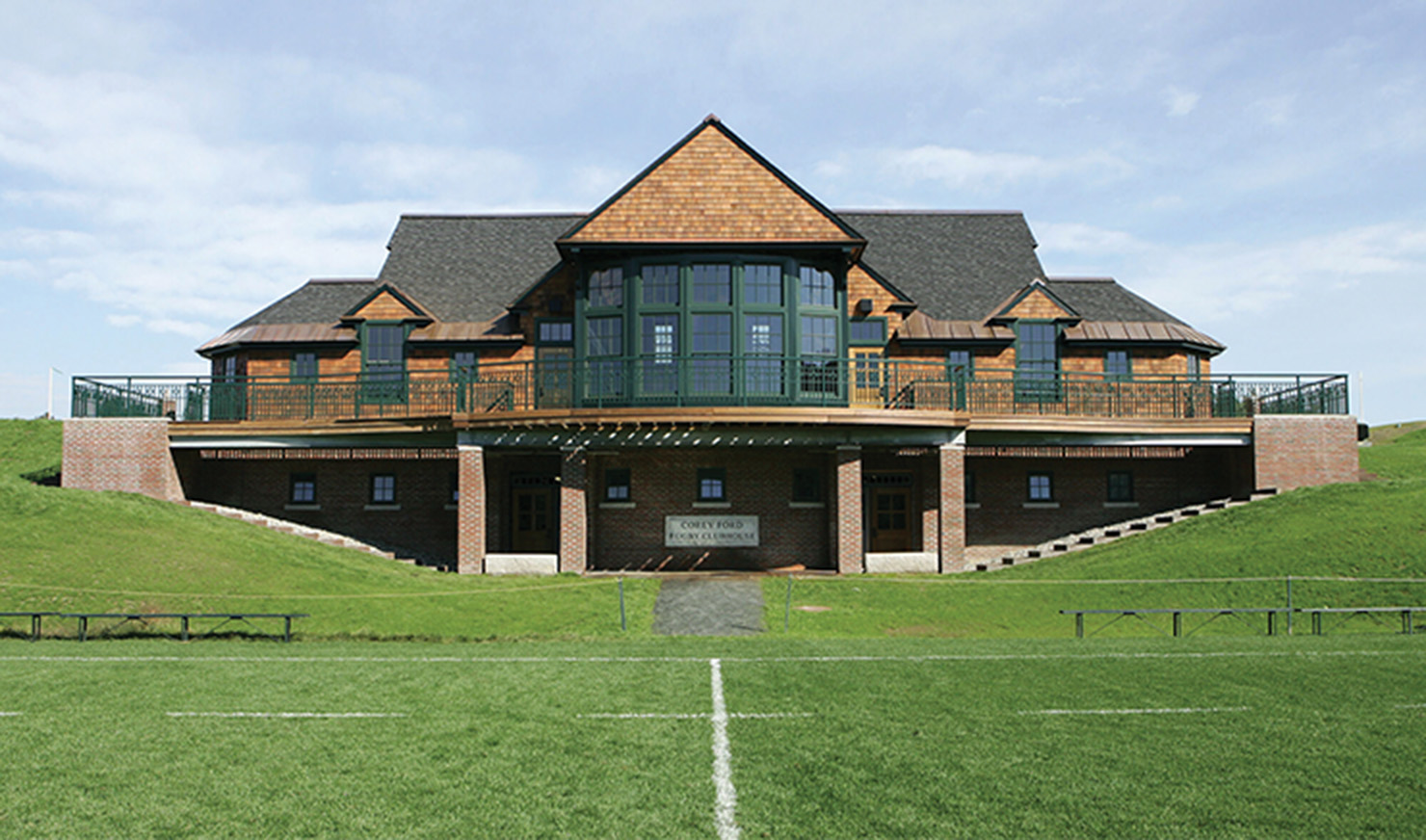
That building, the 6,000-square-foot Corey Ford Clubhouse, is now one of the premier facilities in all of college rugby, complete with locker rooms, observation deck, office space for coaches, and a kitchen, trophy room, and clubroom. With renovations completed in June it is even grander—thanks to funding from both the College and private donations.
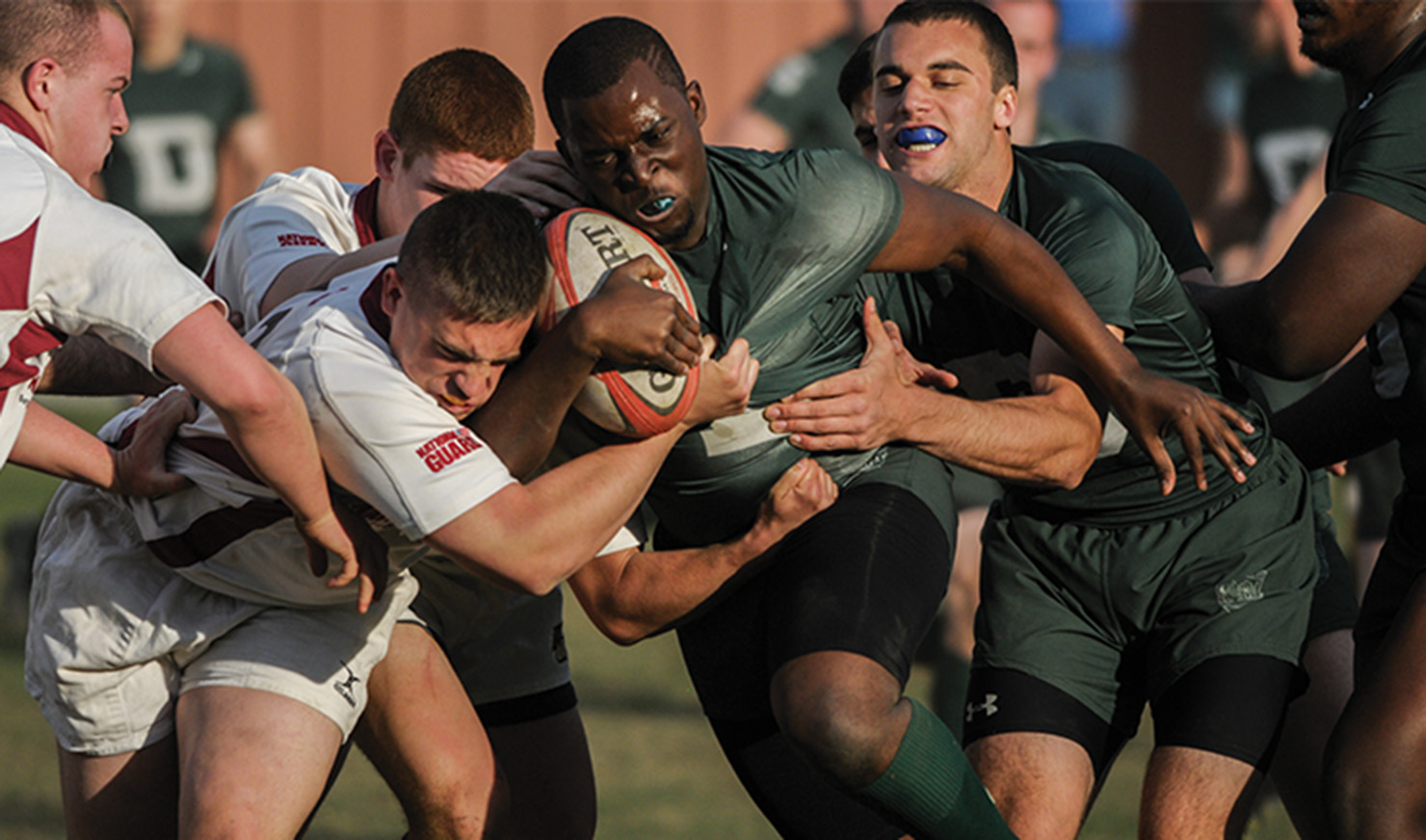
As DRFC prepares to celebrate its 75th anniversary in September, the club has come a long way from its rogue roots. It has grown into a perennial national contender, winning the USA 7s Collegiate Rugby Championship in 2011 and 2012 and finishing runner-up for a national title several times, including last spring. Even as the funding and professionalism have increased, though, DRFC remains defined, as in its earliest years, by a dedication to having fun.
In 1951, it would have been difficult to imagine the fledgling club would exist seven decades later—let alone play home games on a rugby field of dreams that makes other clubs jealous. DRFC was founded as a ploy for a group of Dartmouth students to spend spring in Bermuda, whose national athletics board subsidized travel costs for participants in its rugby tournament.
“They were giving away basically free trips to Bermuda to create a rugby team to play in this tournament,” says Alex Magleby ’00, longtime Big Green coach and a captain his senior year.
The squad of football, lacrosse, and soccer players that descended on Bermuda was a rugby team only in name. Many of them had little understanding of how to play the sport invented in England. It was hardly popular among young Americans.
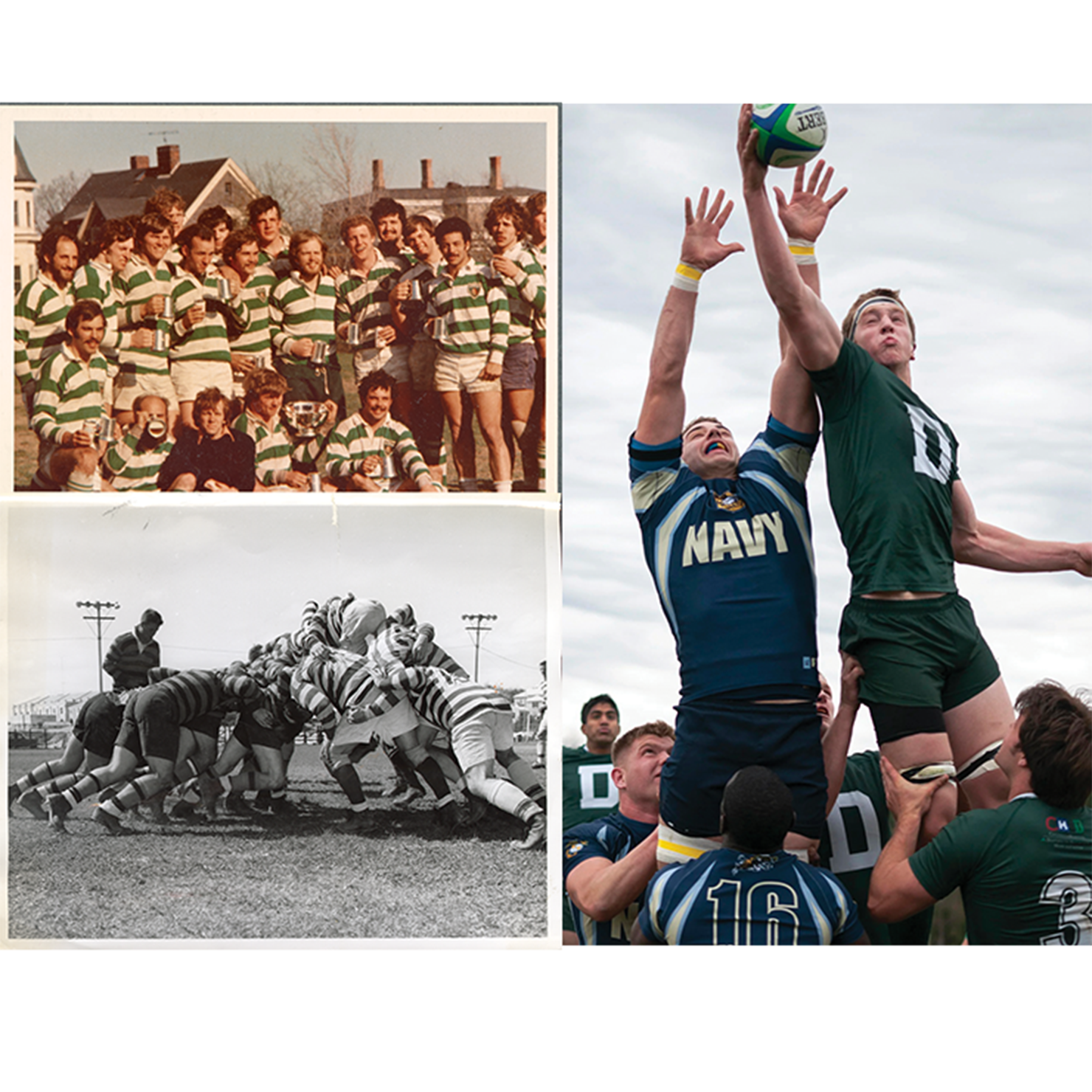
The team went back to Bermuda for spring break 10 times in the next two decades on a trip players call their “tour.” On their 12th trip to the island, the players’ bad boy behavior caught up to them. In 1974, four Dartmouth players were arrested for streaking and were unable to return home with the team. Kenslea was on that trip—and later that spring was elected club president as a rising senior. By then, word of the streaking incident had reached Dean Carroll Brewster. Kenslea was called into his office.
“We were told that the rugby team needed to get its act together or there were going to be repercussions,” Kenslea says. “So we made a determination to take things more seriously and try to improve our performance both on and off the field.”
As the club cleaned up its on-field performance, its leadership structure evolved as well. Prior to 1975, Young says, senior captains typically took on the role of coaching. Then Geoffrey Parkins, Adv’79, a physics doctoral student from England who had played rugby growing up, stepped in as a de facto coach. He set in motion a tradition of graduate students serving as player-coaches. Eventually, DRFC started turning to people other than players to coach. By 1983, the club used its trust fund to import guest coaches from abroad and domestically, though they received no salary.
Young, who coached from 1986 to 2000, made it his mission to mentor inexperienced players in the finer points of rugby. He taught everything from the art of the scrum to the difference between rucking and mauling. As smart students, the guys caught on quickly.
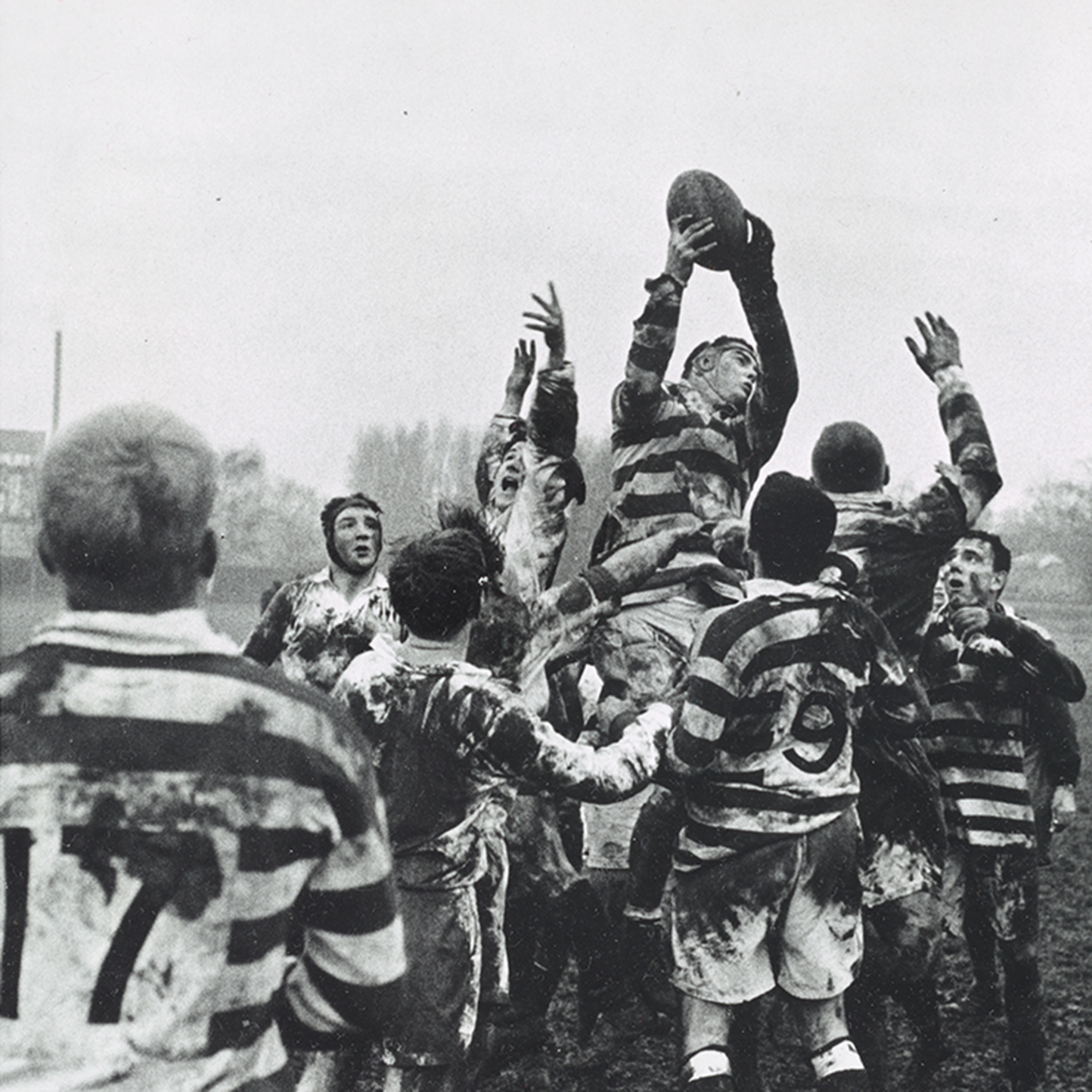
The rugby team needed to get its act together ... so we made a determination to take things more seriously and try to improve our performance both on and off the field.”
—Dan Kenslea ’75
“We had a ton of fun because we were this small school of nerds in New Hampshire, only a few of whom had played rugby prior to coming to Dartmouth,” says Kevin Whitcher ’99, “but then we were able to play with the best schools in the country—and beat them.” He had planned to join the soccer team when he saw a flyer for DRFC. “I was like, ‘Eh, what the heck? I’ll try it out,’ ” he recalls. “I showed up with the other freshmen and had more fun that afternoon than I’d had playing sports my entire life. I decided to play rugby.”
Kenslea says the team benefitted from the College’s large number of football players. About 125 of the nearly 850 freshmen tried out for football, but by the time they were sophomores, only 50 or 60 could play on the junior varsity or varsity teams. That left 60 or more football players available to pivot to rugby.
By the 1970s, DRFC established a tradition of older players, some of them major talents, mentoring newcomers. By the late 1990s, the club had legitimate coaches. When Whitcher showed up to his first rugby practice freshman year, an older guy started talking to him. “I didn’t know him from Adam, and he kind of pulled me aside,” Whitcher recalls. “He’s like ‘Hey, I’m gonna kick the ball, and then I want you to go catch it.’ He turned out to be the former Welsh international star, Gareth Williams.”
Another mentor was Torbjorn Dimblad ’97, a captain who grew up in England and took the freshmen aside to teach them rugby. Along the way, Whitcher and his teammates learned something else central to DRFC: leadership across the board. “As a freshman you’re just grateful to have leaders above you who showed you what to do,” Whitcher says. “Then everybody has that moment of stepping into a leadership role and realizing it’s your responsibility.”
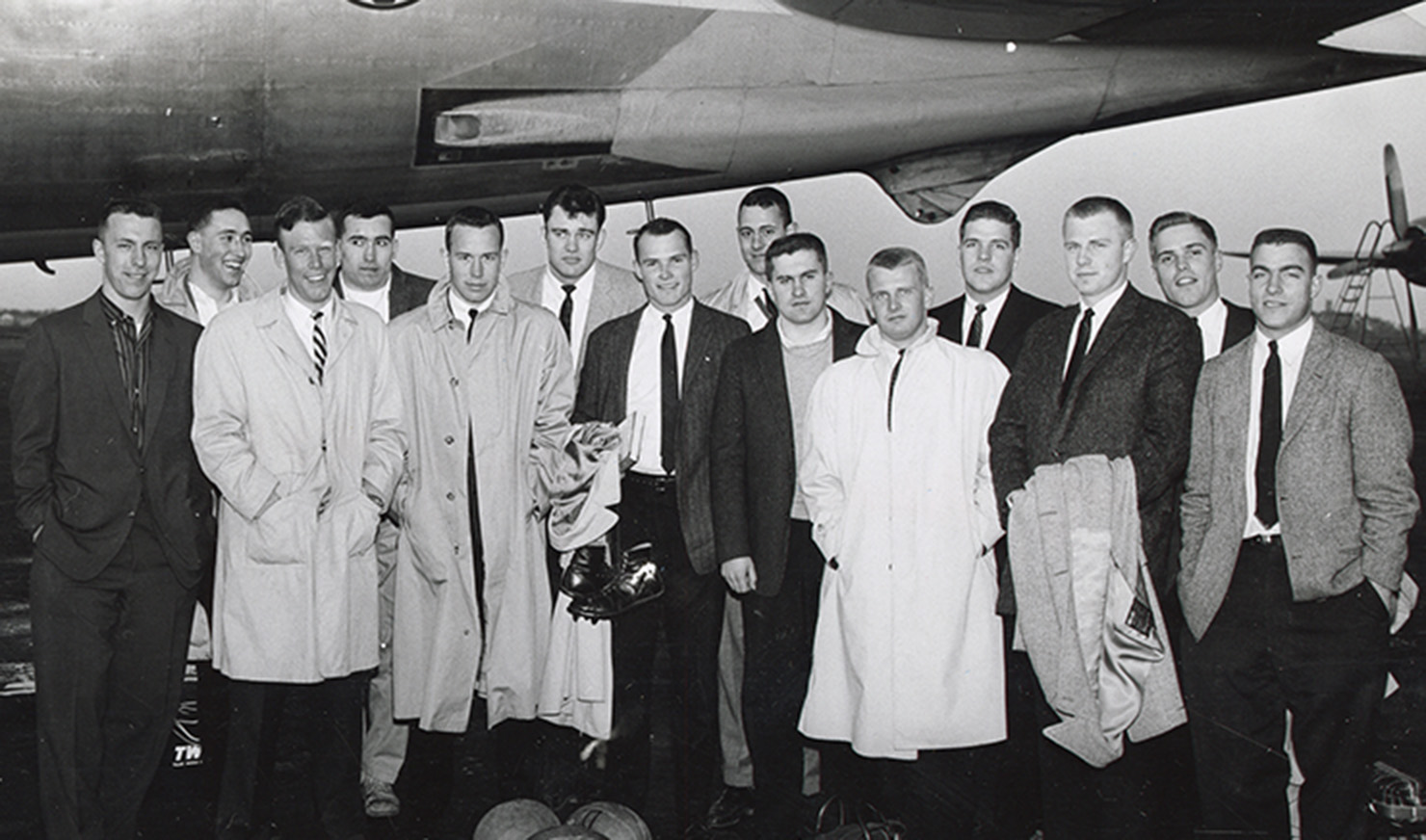
When Magleby graduated in 2000 and began playing with the U.S. national team, he was asked if he would serve as the club’s interim head coach for the fall of 2001. He agreed and immediately took the program’s professionalism up a notch. It was long overdue.
Although rugby was changing dramatically around the world—including going professional in 1995—DRFC still operated as an amateur club largely outside the purview of the College athletic department. Magleby recalls players lifting without a trainer and practicing in Leverone Field House at midnight, the only time they had access. When players got hurt, instead of going to Davis Varsity House to meet with athletic trainers, they landed among all the students at Dick’s House.
Magleby knew that needed to change, so he pushed. He met countless times with President James Wright, including when the College almost swapped the land where the Corey Ford Clubhouse now sits with Hanover High School. In time, he secured the club much-needed improvements, including an athletic trainer and concussion testing. This heightened professionalism, including the opening of the Ford clubhouse in 2005, brought much success. With Magleby coaching from 2001 to 2012, Dartmouth won the Ivy League championship nine times, setting it on a path to Ancient Eight dominance.
Today, the program employs three full-time coaches led by Kyle Sumsion, also former head coach of the U.S. under-20 national team. DFRC boasts a full-time strength and conditioning coach and access to the Floren Varsity House weight room and the Graham Indoor Practice Facility. Alumni raise about $400,000 every year to support rugby.
Meanwhile, the women’s rugby team, founded as a club sport in 1978, has gained varsity status and won three National Intercollegiate Rugby Association championships in the last decade. It is one of the College’s most successful athletic programs. Despite all the on-field success of Dartmouth rugby, Magleby believes the men’s team can maintain its roots as a player-led organization. “As long as the core remains—which is about student-athlete leadership development—then that’s amazing,” he says.
Coach Sumsion has bought into that vision, regularly meeting with the athletic department to make sure DRFC gets its share of College support. But men’s rugby is still a club, and he leaves scheduling to those who have always done it: student ruggers. “The guys are getting ready to suit up on game day, but they’re also connecting with the visiting teams, making sure they have the directions and the timelines,”
Sumsion says. The players also plan their tours, trying to book an international trip at least once every four years. Sumsion has high hopes for the program. He wants top students who are also talented rugby players to apply to Dartmouth. DRFC’s facilities, especially what he calls the “field of dreams” at Corey Ford, make that an easy task, he says, even though Dartmouth does not offer admissions assistance to rugby players. “The second anybody who’s trying to figure out where to go for college and to play rugby comes to the Corey Ford Clubhouse, that decision’s been made for them,” Sumsion says. “It sells itself. There’s no better place to play a game of rugby.”
To celebrate the 75th anniversary, alumni will gather in Hanover on the weekend of September 18. There is a Friday evening reception at the clubhouse, matches and a celebration dinner on Saturday, and the board of governors will meet Sunday.
Will Dehmel is former sports editor of The Dartmouth and a former DAM editorial intern.