

Dartmouth counts many famous Olympic skiers among its alumni, but none have had the impact on their sport quite like John H. Caldwell Jr. ’50, who competed in cross-country skiing and Nordic combined at the 1952 Winter Olympics in Oslo, Norway. That experience proved pivotal to his career—not because he performed well but because he performed so poorly. During the following decades, through teaching, coaching, and writing, Caldwell became one of the most influential figures in the history of American cross-country skiing.
“When someone gets their butt kicked, like he did in Oslo, a lot of people just say no,” says son Sverre ’77, “but for him it was, ‘Okay, how do we get good?’ That was a lifelong venture.”
John Caldwell died February 27, 2026, at an independent living community in Hanover. He crossed life’s finish line at age 97.
Born in Detroit on November 28, 1928, Caldwell moved with his family to Vermont in 1941, when his father was hired as business manager at The Putney School. The school did not have a basketball team—Caldwell’s preferred sport at the time—so, he learned to ski. At first, he preferred alpine racing and ski jumping, but he entered a cross-country ski race—on his sister’s alpine skis—as a senior and helped Putney win place second in the 1946 state championships.
From Putney Caldwell went to Dartmouth, likely drawn by its well-regarded ski team. Again, he focused on alpine racing and ski jumping, not taking up cross country until his sophomore year.
“He was a late bloomer,” says Sverre. “Often late bloomers, if they stay with it, are really eager. When they finally start growing, they suddenly improve because they’ve had to figure out all the other angles to keep up with the big guys.”
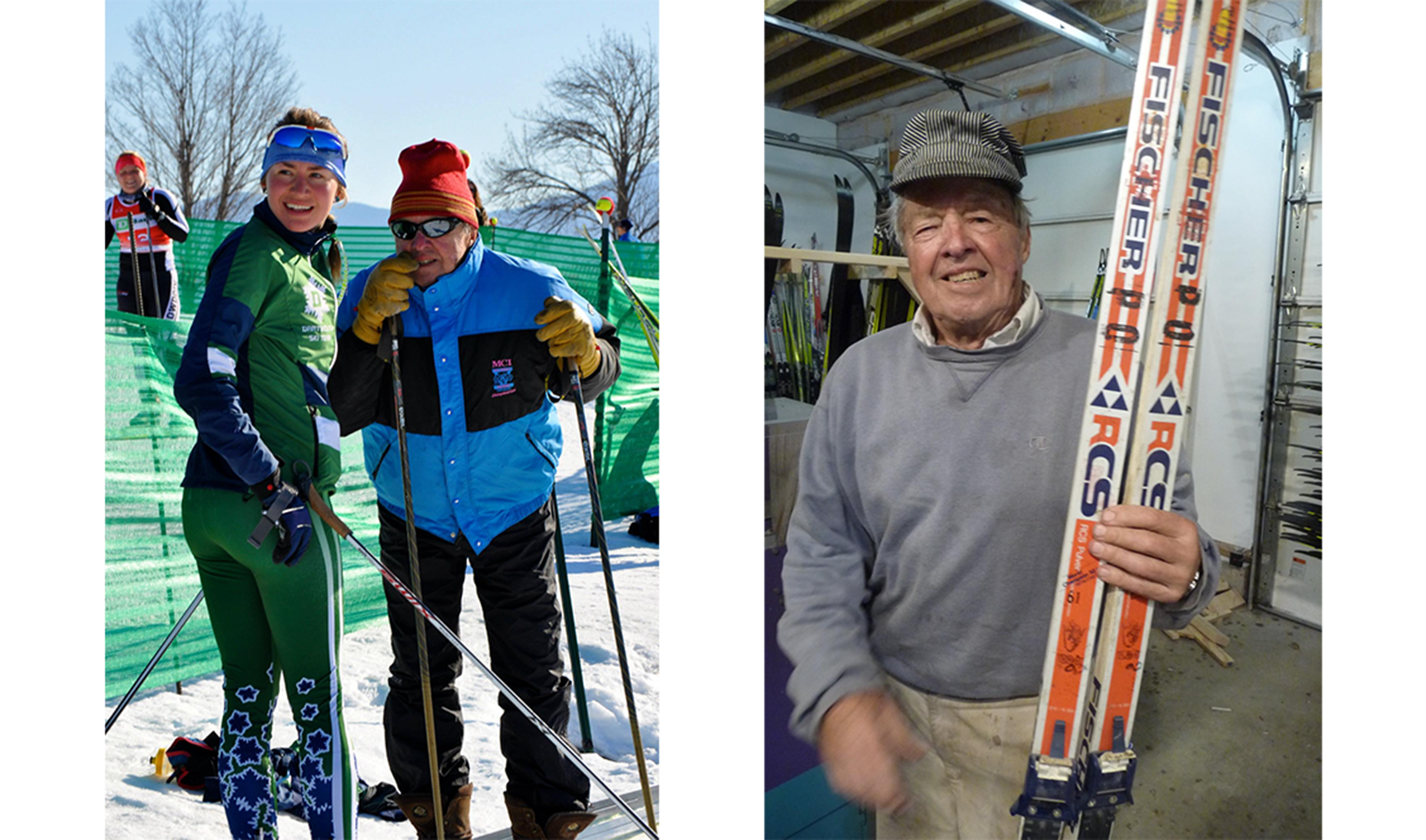
At the time, collegiate skiers competed in four disciplines: slalom and downhill as well as ski jumping and cross country, with the top performer in all four winning skimeister honors. During Caldwell’s senior year at Winter Carnival, he barely missed being named skimeister, finishing second in cross country and first in Nordic combined.
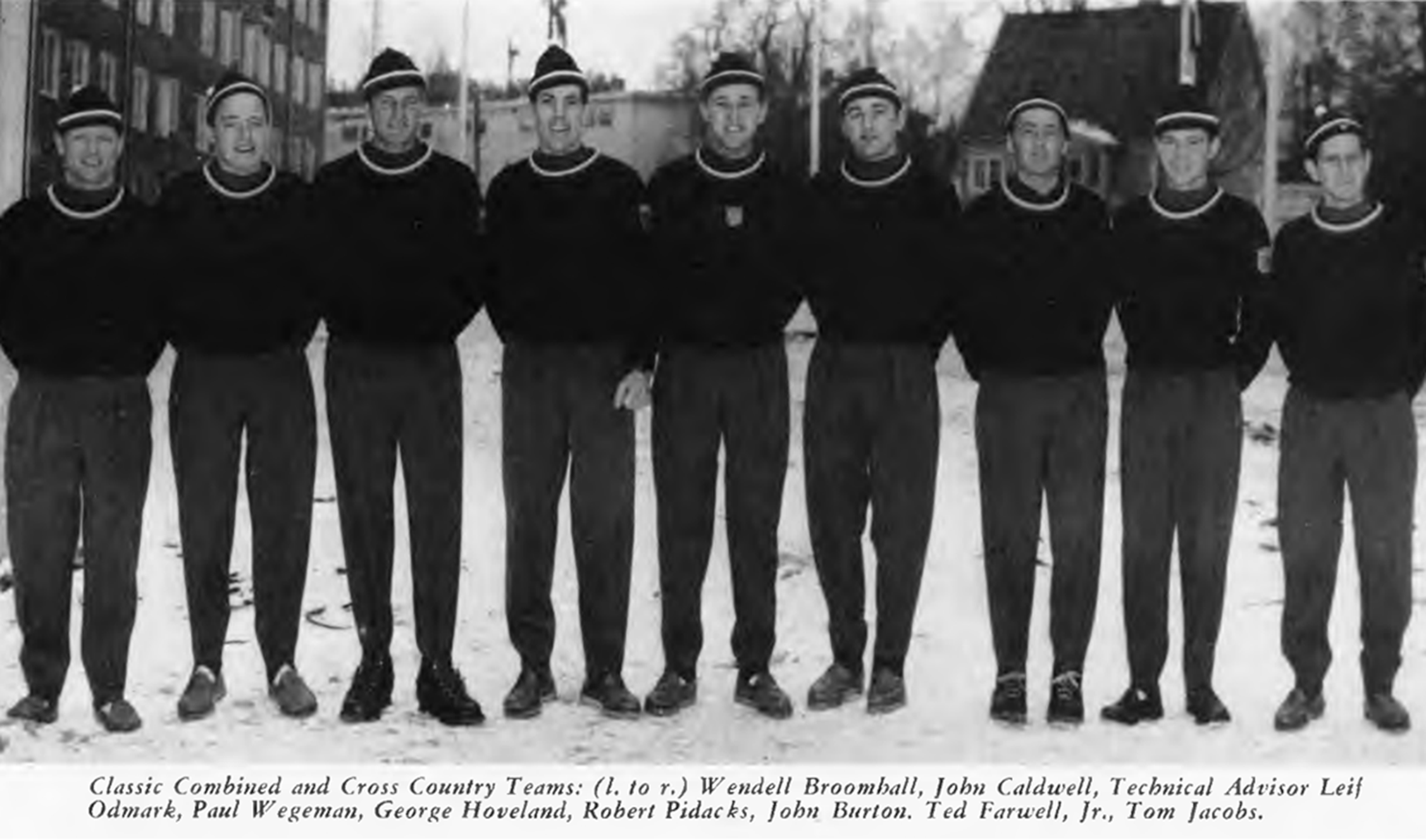
Caldwell graduated with a mathematics degree in 1950 and took a job at Lyndon Institute in Vermont’s Northeast Kingdom. That spring, he drove to Rumford, Maine, to compete in the Olympic trials and earned a spot on the 1952 team. However, with little training, no coach, and too much Norwegian food, Caldwell found himself unprepared at the Games in Oslo.
“We had no idea what we were doing,” he told VT Ski & Ride in 2018. “I fell on my first two jumps, eventually made the third, and got to race cross country, where I think I finished dead last. We didn’t know how bad we were. I was so mad that when I got back to the States, I said if I could do anything to prevent this from happening again, I’d do it.”
He did not actually finish last—two Australians trailed him—but the experience proved transformative. He had witnessed the Scandinavian lifestyle at the Oslo Games, where skiing is just part of life. From this lifestyle, he realized, champions are made.
Caldwell returned home and took a job teaching and coaching at Putney, where the community became renowned as a cross-country skiing incubator. Multiple Olympians came through his program, including Martha Rockwell, a member of the first U.S. Olympic women’s cross-country team in 1972, and Bill Koch, who won the first U.S. Olympic cross-country skiing medal with a silver in 1976. He also coached his eldest son, Tim ’76, a four-time Olympian.
Caldwell coached five U.S. Olympic teams (from 1960 to 1972 and 1984) and directly or indirectly had a connection to every Olympic medal won by American cross-country skiers. One of his athletes, Jim Galanes, later founded Gold 2002, which became Alaska Pacific University’s elite Nordic program. Kikkan Randall, who won Olympic gold for the United States in the team sprint in 2018, joined Gold 2002 at the start of her career.
For his part, son Sverre shaped the Stratton Mountain School (SMS) in Vermont into one of the top Nordic programs in the country and in 2012 helped found the SMS T2 elite team. Four-time Olympic medalist Jessie Diggins joined that team in its inaugural year. Ben Ogden, who won two silver medals at the 2026 Winter Olympics, is also a product of SMS’s Nordic program.
Caldwell’s influence extended well beyond elite competition—he is considered by many to be the father of U.S. cross-country skiing. His The Cross-Country Ski Book, first published in 1964, sold more than half a million copies and introduced generations of Americans to the sport. He also helped found the New England Nordic Ski Association (NENSA), which became a cornerstone of cross-country skiing in the region, promoting both learn-to-ski programs and racing.
“He really loved the sport,” says son Tim, “and he just loved seeing people ski and did anything he could do to help it grow.”
Caldwell was also a devoted family man. He married Hester “Hep” Goodenough in 1952, and they raised four children, all accomplished skiers. Tim competed in the Winter Games from 1972 through 1984 and reached a World Cup podium in 1983. Sverre’s racing career was cut short by injury and illness, but he discovered coaching while at Dartmouth. Son Peter skied for Bowdoin College and daughter Jennifer was an All-American at the University of Vermont and won the American Birkebeiner in 1983.
Many of the 10 Caldwell grandchildren—including Isabel ’14, Austin ’15, Patrick ’17, and Sophie ’12—remember fondly “Camp Caldwell” run by their grandfather, “Grumps,” short for “Grumpy Bear.” Every summer Grumps and Hep hosted the grandchildren in two groups—the older five and the younger five—at their hillside home in Putney. Days included hiking, swimming in the (cold) pond, and completing daily chores.
Despite the work, “It never felt like a drag to be there,” says Sophie, Sverre’s daughter and a two-time Olympian. The cousins relished time together. The summers also strengthened the grandchildren’s relationship with their grandparents. As Sophie rose through the ranks of international skiing, Grumps always wanted a race report.
“It was very clear that he was up watching the race and paying attention to the details,” Sophie says with a laugh.
Caldwell loved sharing stories from his Olympic experience and stayed engaged with the sport throughout his life—happy to talk about skiing all day.
“My specialty was skate sprinting, and neither skating nor sprinting existed when he was ski racing,” Sophie explains.
“He was a student of the sport and wanted to learn.”
Most of all, she says, “Grandpa was always just Grandpa, and Dad was always just Dad. They did a very good job making it clear that skiing was something we shared and were passionate about but there was no expectation that we had to continue the family legacy.”
After Hep died in 2018, Caldwell reluctantly left Putney for a retirement community in Hanover—agreeing only because it was near Dartmouth. He closely followed the fortunes of the Big Green ski team and had long urged the College to install snowmaking at Oak Hill, which eventually happened. At the 2024 Carnival, where the snowmaking system made its race debut, Caldwell toured the course in a snowcat and handed out awards after the races.
Shortly before he passed, Caldwell was thrilled to see three more U.S. skiers win Olympic medals at the 2026 Games: Diggins won bronze in the women’s 10-kilometer race, Ogden claimed silver in the men’s sprint, and Ogden and Gus Schumacher won silver in the team sport.
“I know he was pleased that Jessie and Ben came from Sverre’s SMS T2 team,” says Tim.
“I’m just happy that he lived a good, full life and found a passion in the cross-country ski world,” adds Sverre. “I know he was tickled pink that he, in some way, helped the United States get to a place of respectability.”