

I unbuckled our toddlers from the backseat of the rented minivan after the long ride from Logan Airport. This past July was their first time on campus, and over my shoulder they could see the tents and banners for my 15th class reunion. As they squirmed to get out and join the fun, I squatted down to their level. “Before we go over to see our friends, there’s a tradition we have to do first. We have to visit Richard.”
Richard can be found at the quiet end of a hall in Baker Library, just up a forgotten staircase. We entered at the far end of the Orozco murals, moving backwards through his epic, from the modern world to the ancient. As we passed scenes of war, ritual, and sacrifice, the kids skipped through the cool air of the library. At the end of the room, we climbed the stairs and suddenly came face-to-face with him, set in bronze bas-relief.
Richard Nelville Hall. Class 1915.
Born at Ann Arbor 1894. Killed in Alsace 1915.
Died for France and the Freedom of Nations.
He was the first Dartmouth man to die in World War I.
I discovered this monument in the waning days of my senior year on long walks across campus thinking about John Sloan Dickey’s admonition to make “the world’s troubles … your troubles” and wondering whether I should follow my classmates in looking for those troubles at consulting firms and investment banks. Richard’s cenotaph stopped me.
I was stirred by its idealism. At a time when the United States was still neutral, students at this school in the woods raised money to buy two Ford ambulances and ship them, with four volunteer drivers, to France.
“Is that him?” my daughter asked, pointing to photographs nearby. I scanned them. In the first, his class portrait, Richard is a clean-shaven boy; in the second, taken in France, he’s a mustachioed veteran confident in his cause.
As a student in 2010, in a library filled with portraits and busts of old professors, I realized this was one of the only tributes on campus to someone my own age. Here, Richard is sculpted twice—first young in uniform, then eternal as an allegorical savior, lifted beyond the particulars of his death into something timeless. His monument showed that even in the vastness of a world war, individuals do make a difference and individual sacrifices are heroic.
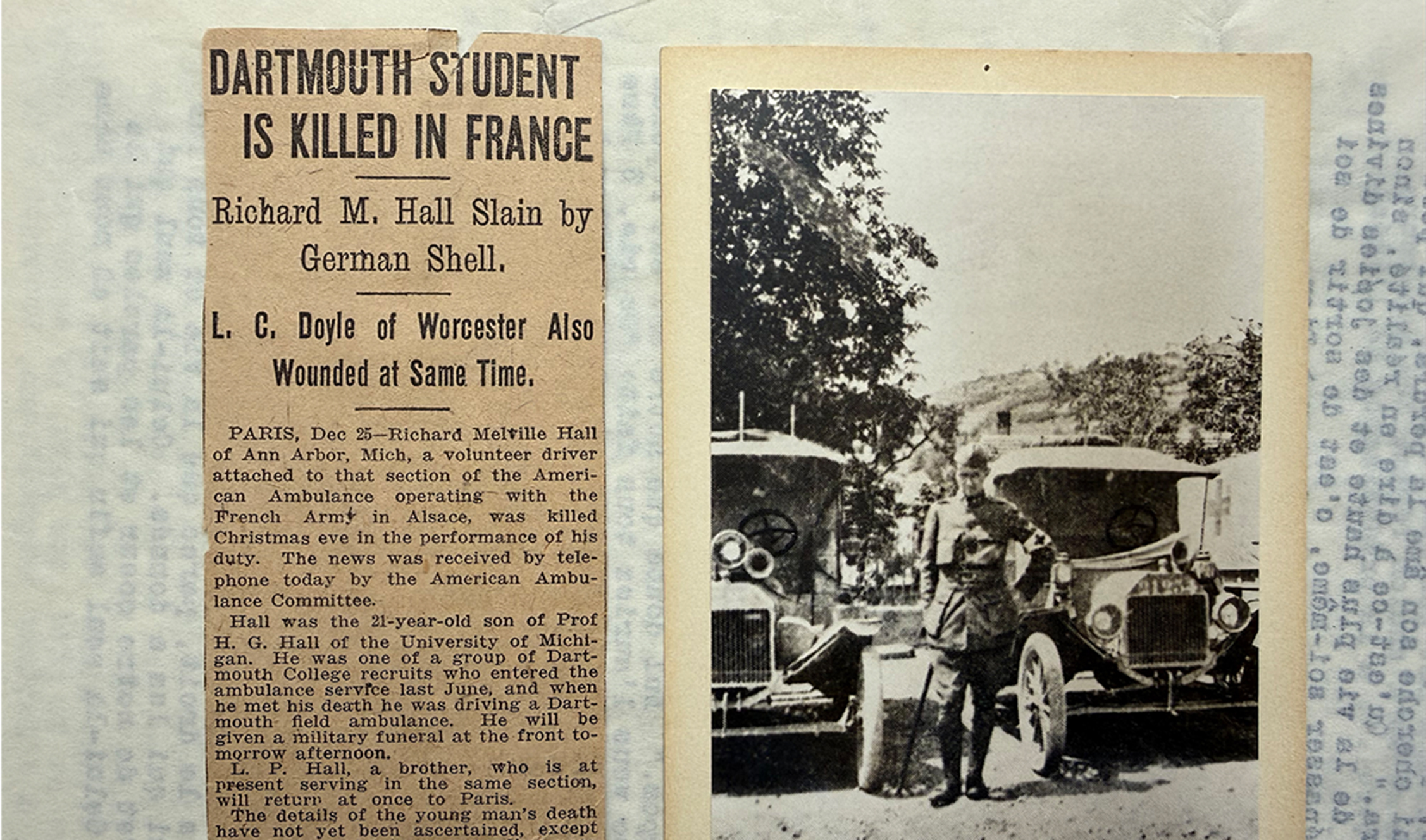
Richard’s monument seemed to ask a question of everyone who walked by: In what cause are you willing to give yourself?
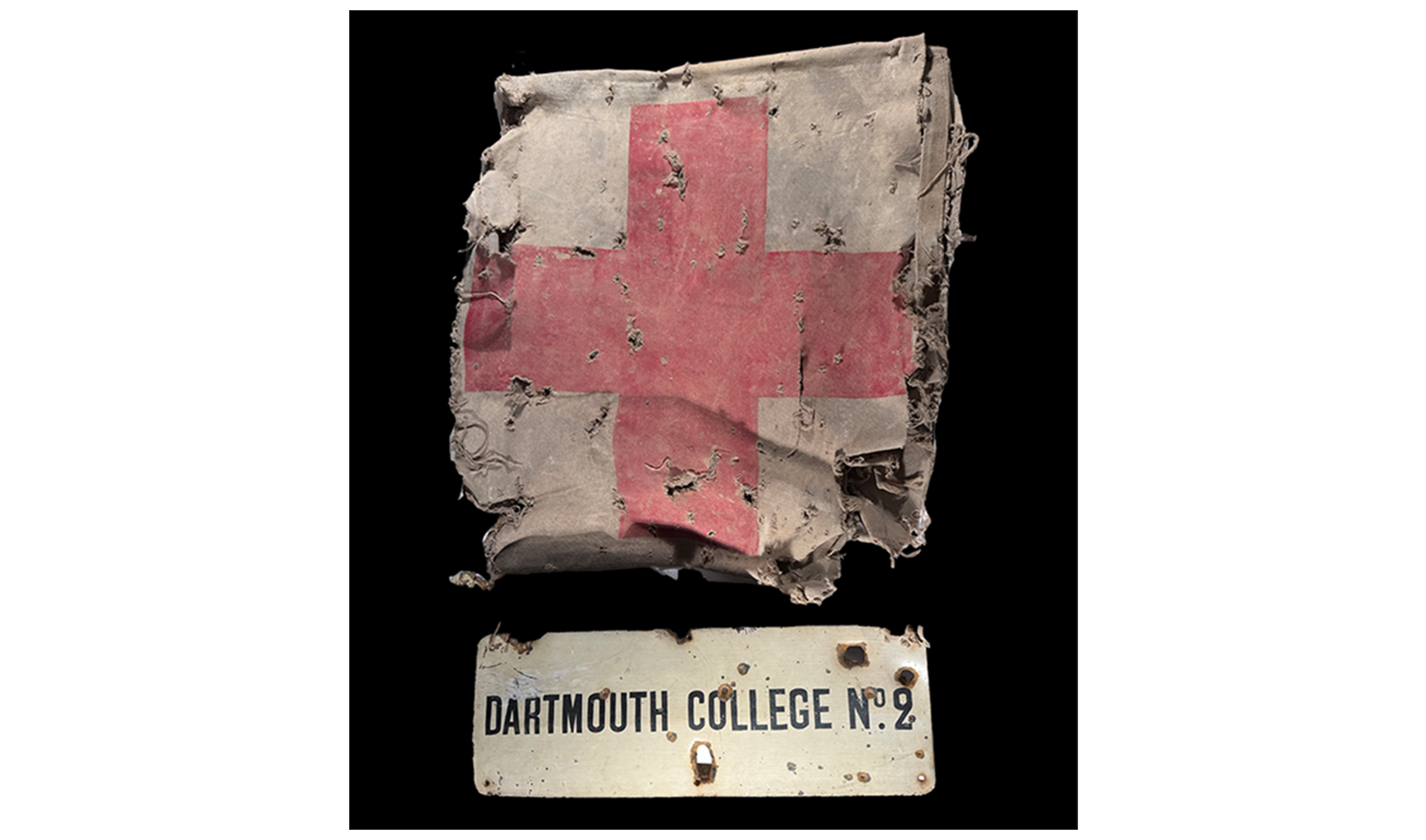
For him, it was saving lives in a world failed by its aging leaders. He was killed by German artillery while driving his ambulance down a lonely mountain pass on Christmas morning 1915. When they found him, Richard’s comrades gathered what remained. Somehow, these artifacts made it out of France and into the display case in Baker: the canvas from his ambulance pierced with shrapnel, the bullet-riddled license plate reading “Dartmouth College No. 2,” and even the German shell that killed him.
That pointy, rusty shell had been there every time I visited Richard through the years: just before mailing in my application to Navy officer candidate school and again when I was on leave from the fleet to attend my wife’s graduation. But it was gone this time, replaced by a letter from Richard Hall’s mother. She was writing to the mother of another Richard Hall at Dartmouth, remarking on the coincidences of their two sons, both nicknamed “Dick,” and the way the campus was reshaped by their untimely deaths. The other Dick Hall, class of 1927, died of polio his sophomore year. In his memory, his parents built and furnished Dick’s House.
* * *
I returned to campus that fall for the Veterans Day breakfast to help present the James Wright Award for Distinguished Service. In a Dartmouth community supportive of veterans but often inclined to see us through the lens of victimhood, this award is meant to show students that service is affirming and worthy.
One veteran we honored, Mike Gish ’49, served in the Marine Corps as, of all things, a combat painter who deployed into combat zones into his late 60s. The other, Tom Byrne ’55, was an Air Force veteran who a decade earlier had helped me establish the Dartmouth Uniformed Service Alumni, which connects military members of the Dartmouth community, supports student veterans, and inspires more students to serve.
Both awards were posthumous.
As the event began and President Sian Beilock delivered her remarks, my attention was fixed on what I planned to say about Tom, an old friend who spent his postmilitary career at the College setting up the Hopkins Center and Kiewit Computing Center. After his final retirement, when he moved from Hanover to Georgia, we drifted out of touch. It was only while reviewing the award nominations in the early autumn that I realized he had died.
His obituary photo looked exactly as I remembered him—infectious smile, sleeves rolled up, sharpened pencil ready in hand. I also learned, too late, that his celebration of life had been held in Hanover during my reunion, a fact that weighed heavily on me. His family was there to accept the award on his behalf, and I wanted to make sure they knew how much Tom had meant to me.
I was so focused on getting the words right that I only dimly registered when Beilock concluded her remarks by announcing that the College would double ROTC and veterans enrollment—twin causes Tom and I had long fought for.
After the breakfast, I took a walk to look at the other campus memorials. My first stop was a plaque on Main Street outside town hall recognizing “the singular accomplishments of Thomas E. Byrne III … citizen extraordinaire of Hanover, NH.”
At Buddy Teevens Stadium, I peered through the gate at the original World War I monuments that gave Memorial Field its name and inspected the new ones recently installed. One, donated by President James Wright, revised a memorial to those “who gave their lives in the armed forces, 1965-1972,” so as to finally have the courage to speak the name of the war: Vietnam. Another recognized “all Dartmouth Men and Women, who served, are serving, or will serve their country in war and peace.”
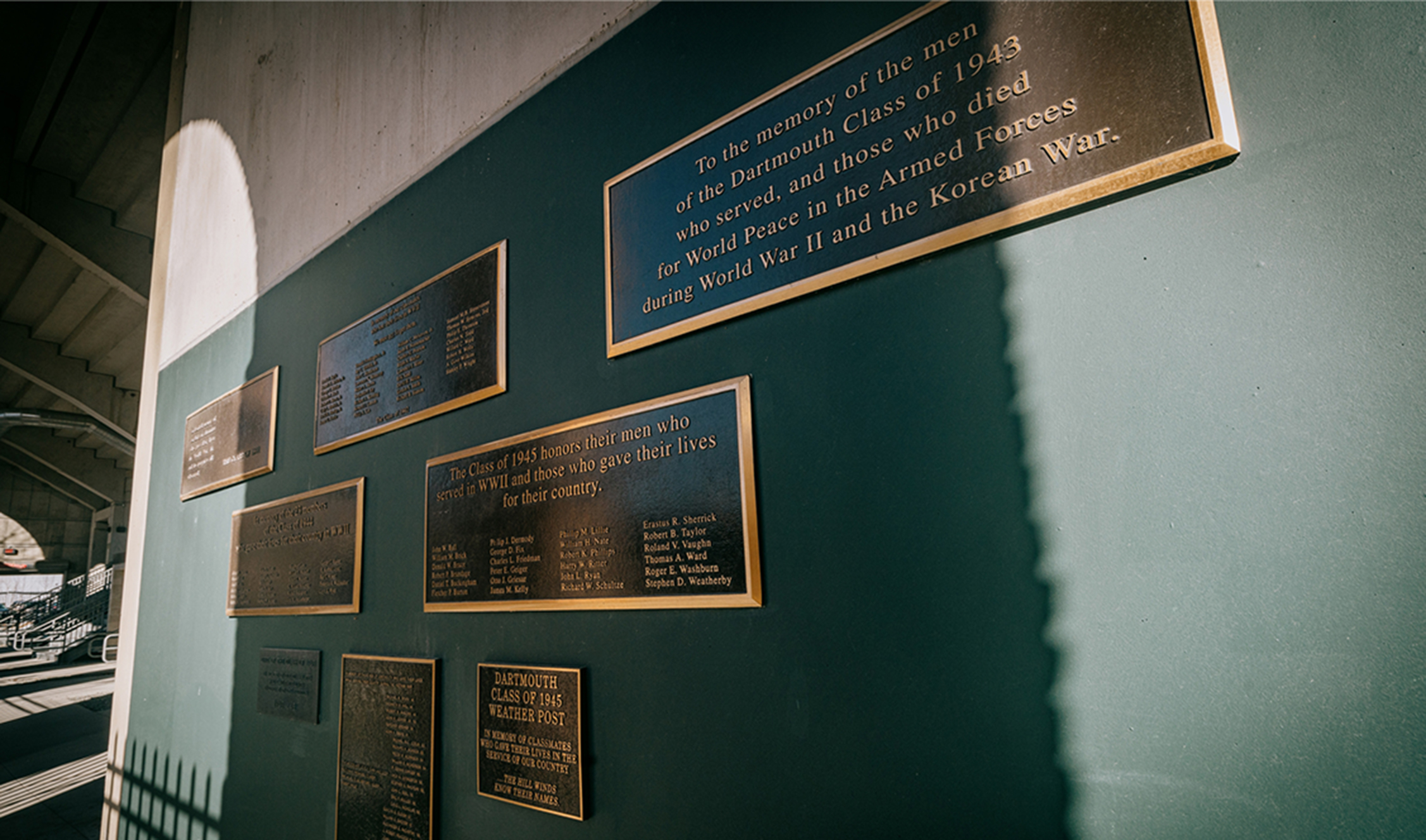
Surprised, I realized that this one applied to me.
I read the familiar lines etched into the granite of the World War II monument—words familiar to any Dartmouth ear but that somehow carry their true weight only when set in stone:
The mother keeps them in her heart and guards their altar flame,
The still North remembers them, the hill winds know their name,
And the granite of New Hampshire keeps the records of their fame.
Next, I visited Webster Hall to see its massive doors, the College’s memorial for the Civil War. President Ernest Hopkins once observed that no college had a larger proportion of its men enrolled in the armed forces during that war than Dartmouth—a legacy of service that later inspired him, as president, to mobilize campus to near-total participation in World War II.
I peered inside at Rauner Special Collections Library, where, as a student, I got to hold Shakespeare’s First Folio in my bare hands. Today, on a whim, I requested to hold Richard’s shell.
The librarian sat me down at a long oak table and brought out the full file on Richard Hall, which was so extensive and impressive that I shudder to think what the College still has on me. I held the riddled canvas that once covered his ambulance, its smell of mud and smoke faded with time. I unfolded a program for his memorial service—beautiful and pristine even a hundred years removed. I saw the plans for a second monument to him, built by the class of 1915, and photos of its unveiling—held abroad in France at Richard’s gravesite—to coincide with the class’ five-year reunion.
Then I read the letter describing the circumstances of his death. At 4 o’clock that Christmas morning, another ambulance driver “found one of our Fords so destroyed it could not be distinguished; the top of the car was up in the tree and so were the extra tires, there was nothing on the ground but a chassis.” Crawling down the ravine to collect some of the ambulance’s blankets that must have been scattered by the explosion, the driver found Richard “lying on his side with his arms fixed as if driving and in a sitting position cold and rigid.” When he went back up to the road for assistance, the next person on the scene was another volunteer driver, Louis Hall—Richard’s brother. Put in that impossible spot of what to say, the driver deflected and made up an excuse about stopping to fix his brakes. He gave Louis just a few more moments of Christmas morning, a few more moments of a world with Richard in it.
And then there was the final box, the one custom built to hold the shell. I held the jagged piece of metal that killed Richard Hall in my hands. It was heavier than I imagined. It made me think of the commitment I made at Richard’s age when I joined the Navy—and how far that decision now seemed from my life today, a decade out of uniform, with a young and happy family. Turning it over in my hands, I wondered: How would I answer the question of Richard’s monument today?
Is there still a cause in which I am willing to give myself?
Nathan Bruschi is a U.S. Navy veteran and cofounder of the Dartmouth Uniformed Service Alumni. His writing has been published in Wired, The Hill, Business Insider, and The Minnesota Star Tribune.