


Three large, geometric-themed artworks hang in one corner of a second-floor gallery at the Hood Museum of Art. On the left is a hulking sculptural painting on a shaped canvas from 1966 by Frank Stella. In the center is a 250-year-old Mexican serape by an unknown artist, and to the right is Dan Namingha’s 2023 painting, Points Connecting 45.
They’re an unlikely trio but rich with visual and historical associations. All three pieces showcase hard-edged shapes. The Stella is brash and anchored with an enormous red triangle. The woven serape is smaller with a softer appearance but plenty of electric zing in its angular patterns. The painting by Namingha, a Hopi artist with a protean oeuvre, has a rhythmic array of forms suggestive of musical notation or perhaps a larger, Platonic order.
As part of the Always Already exhibition, the three pieces encapsulate director John Stomberg’s approach to curation. By breaking down walls between periods and genres, the placement connects graphic and cultural themes and invites viewers to experience, enjoy, and ponder connections between diverse artworks across space and time. “Whether you’re scratching onto a stone or painting on a body or painting on canvas with acrylics, it’s a related impulse,” says Stomberg. “Ultimately, we feel that we learn more from bringing things together than we do from isolating them as separate stories.”
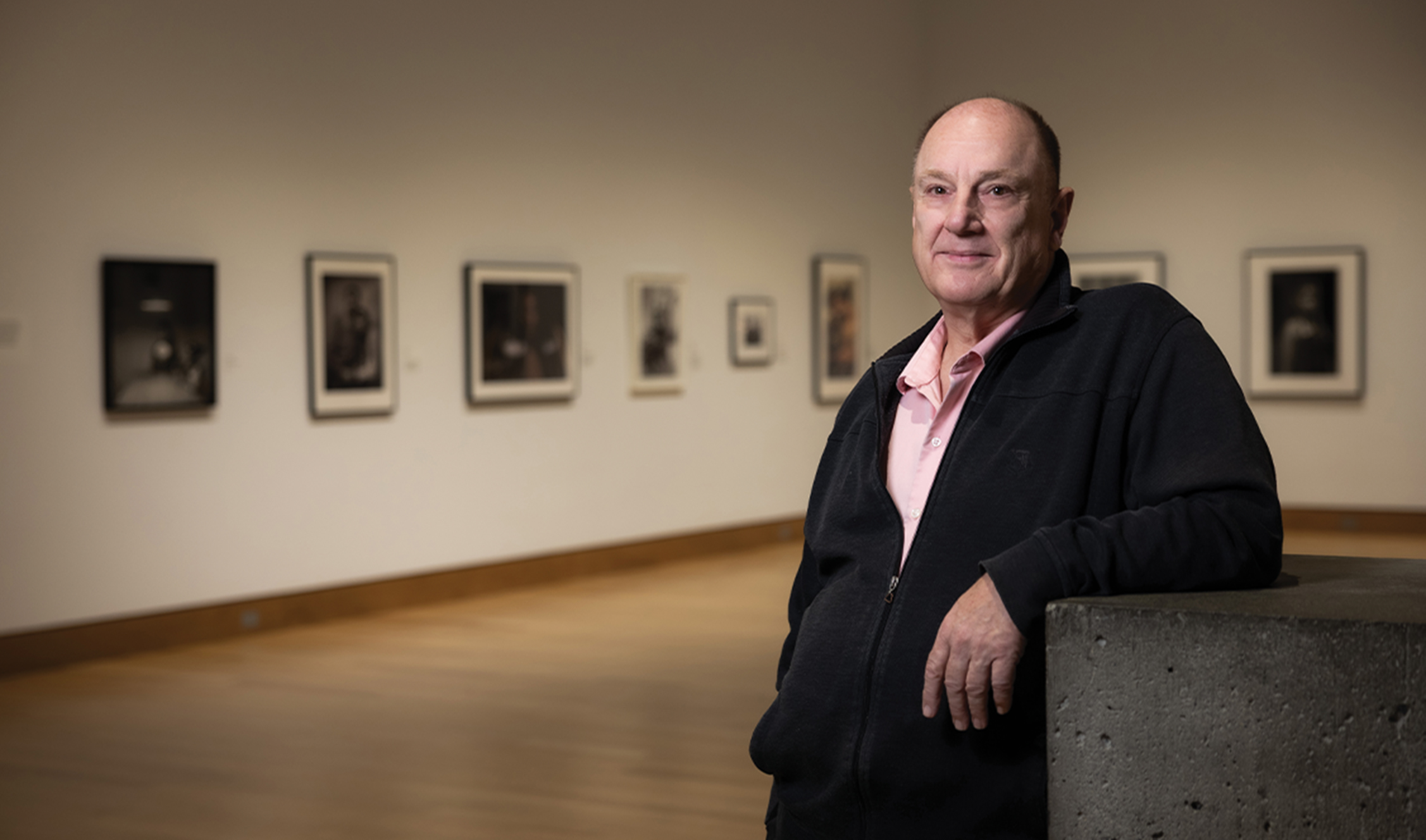
In June, after 10 years as director of the Hood Museum and a storied, four-decade career as a curator and museum director, Stomberg will retire. He will leave behind a vibrant and transformed Hood. Drawn to art through studio classes as an undergraduate at Georgetown University, Stomberg worked in Washington, D.C., galleries after graduation. He went on to earn a Ph.D. in art history at Boston University, where he was also director of the Boston University Art Gallery. Through the years, he served as chief curator at the Williams College Museum of Art and then director of the Mount Holyoke College Art Museum and Joseph Allen Skinner Museum prior to taking the helm at the Hood.
Along the way, Stomberg won numerous recognitions for his work, including three awards from the Goethe-Institut, and has been lauded by peers. “Museum leadership requires an incredible range of responsibilities, and few juggle the balls with as much dexterity as John,” says Pamela Franks, director of the Williams College Museum of Art. “John is a unicorn. He has all of these abilities, and it is remarkable how he manages to balance the wide-ranging parts of the job.”
Stomberg’s focus on pairing widely divergent pieces of art is first and foremost about creating intriguing experiences for viewers, but he also has important cultural reasons for mixing things up. “One of the downsides that a strict focus on historical periods in art can have is to make it seem as though an entire civilization no longer exists,” he says. “That really happened, for example, with Native Americans, as if that culture was no longer vibrant and moving forward. Because of that, we have endeavored for Native American art and for art from other places, such as Australia, to tell the histories, but also bring it up into the contemporary.”
At any given moment, we can offer solace or provocation. Both are present—sometimes in the same work of art.”
—John Stomberg
In 2010, the Hood received a gift of more than 300 works of contemporary Australian Aboriginal art from Will Owen and Harvey Wagner, which instantly gave the museum one of the most important collections of such art in the United States. In 2022, the Hood showed a collection of Aboriginal Australian bark paintings from the last 80 years. “That show traced a pictorial tradition that we think goes back 80,000 years, which is now informing contemporary art practice in Australia. That’s just astonishing,” Stomberg says. “A key tenet for us is that Indigenous cultures are thriving and we’re not paying attention.”
One of Stomberg’s major achievements was managing the museum’s renovation, a three-year redesign and rebuilding project that included a complete reinstallation of the collections. “Reimagining how our collection fits together was a major goal for the renovation and expansion of the Hood. For almost two years, we had full curatorial sessions on Tuesday afternoons,” he says. “At first, they were huge, broad, general conversations about our values. And the answers were that we want to be an international museum, we have international holdings, and we want to have a global view.”
While the museum was closed for the renovation, Stomberg kept its programs going, opening a satellite gallery, dubbed “Hood Downtown,” on Main Street in Hanover. “It seemed it would be a real loss to just close up for three years,” he says. The gallery space became a cultural hotspot and enabled the museum to continue some K-12 teaching programs and teaching collaborations with the College. The downtown gallery also drew audiences that might not have ventured into a museum. “We’ve been trying to learn from that experience ever since,” Stomberg says. “One thing I love about the new Hood is that we now have glass doors and a face on the Green so people can see us.”
As part of Dartmouth, the Hood is a teaching museum, and as director, Stomberg has worked to collaborate with and serve the College. “While many art museums use metrics such as ticket sale income for exhibition success and rarity and beauty to determine what art to buy, we travel a different path. Our shows are successful if faculty and students use them and if the community visits,” he says.
“Working with John has always been a pleasure,” says professor Tricia Treacy. “When I began as chair of the studio art department in 2022, I approached him about reviving a previous collaborative programming initiative,” where artists in residence at the College would show their work at the Hood and give casual talks about their art during pizza lunches. “He was immediately open and enthusiastic. It has become a wonderful opportunity to meet the remarkable artists who come to campus each term.”
Stomberg estimates about 7,000 students annually visit the expanded Bernstein Center for Object Study, which has three spacious classrooms designed for viewing and examining artworks in detail. “Close study of the actual thing teaches lessons beyond those we learn through viewing pictures or reading histories,” Stomberg says.
Professors and students from different disciplines frequently have quite different takes on what is interesting or noteworthy about an object they examine, and that is fine with Stomberg. “The last 30 years have been a little humbling for teaching museums as we realized that art history, while an amazing study and deeply informative, was only one of the many studies that could be applied to the various objects we hold in our museum,” he says. “When the psychology department comes in and they talk about the way that parts of our brain are enacted as we engage with different parts of an object, it’s fascinating. We like to think the Hood has a mutual learning model where we learn together with the people who come in here.”
Stomberg returned to painting himself 15 years ago and is adding a studio on his home. “I’ve been a Sunday painter for a long time. I’m looking forward to being a Monday-through-Friday painter.” In the same month he retires from the Hood, he will have his first exhibition, of some of his luminous abstractions, at the AVA Gallery in Lebanon, New Hampshire.
After 40 years in the business, Stomberg’s views on the role of a museum in society have crystallized. “The most important aspect of a museum is how people experience it. The actual stuff—art, objects, material culture—need to be activated by human engagement. And that’s what we focus on—creating opportunities for meaningful engagement with art,” he says. “Our hope is for every visitor to find something that improves their day by coming in. What that means, though, varies greatly. At any given moment, we can offer solace or provocation. Both are present—sometimes in the same work of art.”
Six Favorite Shows
During his 10 years at the Hood, the director curated 14 exhibitions and oversaw many more. These stood out for him.
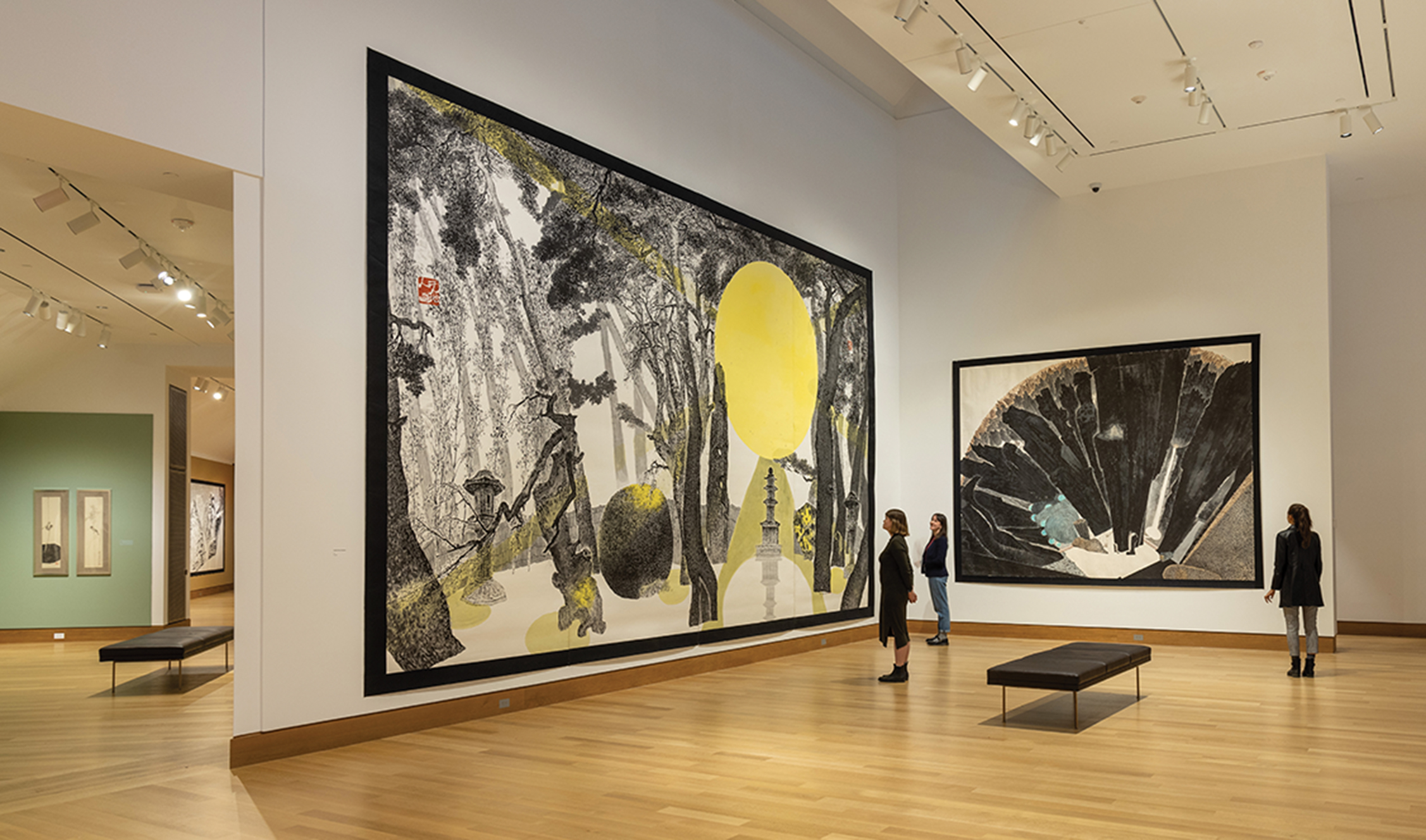
Ink Reimagined: Park Dae Sung (2022-23) was a groundbreaking solo exhibition of the contemporary Korean ink painter. Park is a self-taught artist who saw nature as his teacher and traveled widely, finding inspiration in China, Taiwan, New York City, and the mountains of North Korea. Featuring paintings of enormous scale and refined technique, the exhibition curated by Sunglim Kim traveled beyond the Hood.
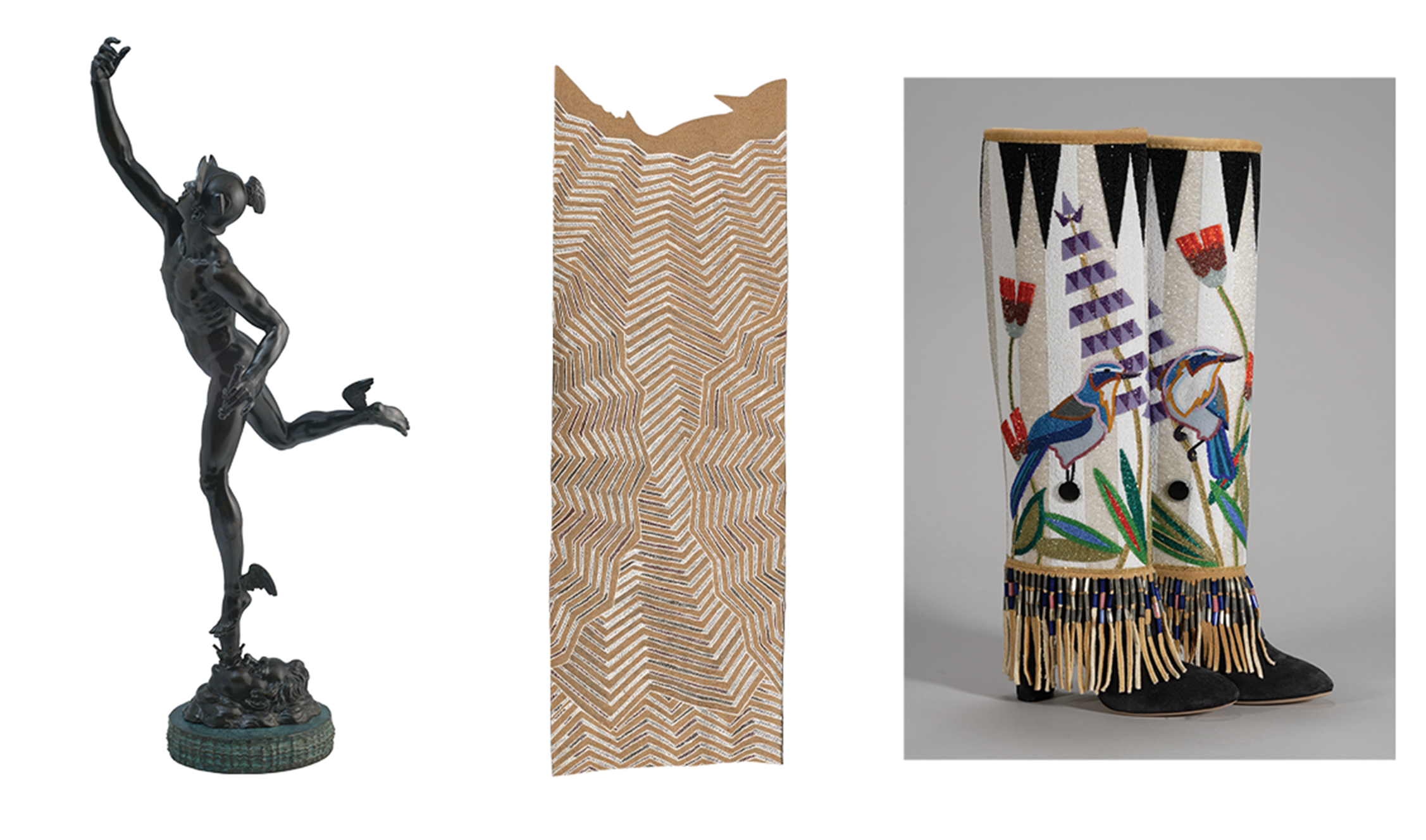
Living with Sculpture: Presence and Power in Europe, 1400-1750 (2024-25) examined the significance of sculpture between 1400 and 1750, an era of profound cultural and social change. Featuring objects made across the European continent—all in the Hood’s collection—the exhibition was accompanied by a major study written by curators Elizabeth Mattison and Ashley Offill. Amid war, colonization, religious conflict, academic upheaval, and social stratification, these works of art ornamented homes, altars, libraries, and collections.
Maḏayin: Eight Decades of Aboriginal Australian Bark Painting from Yirrkala (2022) was an enormous exhibition of Aboriginal Australian bark paintings—literally, ochre paints on tree bark. The show chronicled the rise of a globally significant art movement as told from the perspective of the Yolgu people. More than 90 iconic paint -ings on eucalyptus bark invited audiences to discover the sacred, the beautiful, and the power of art.
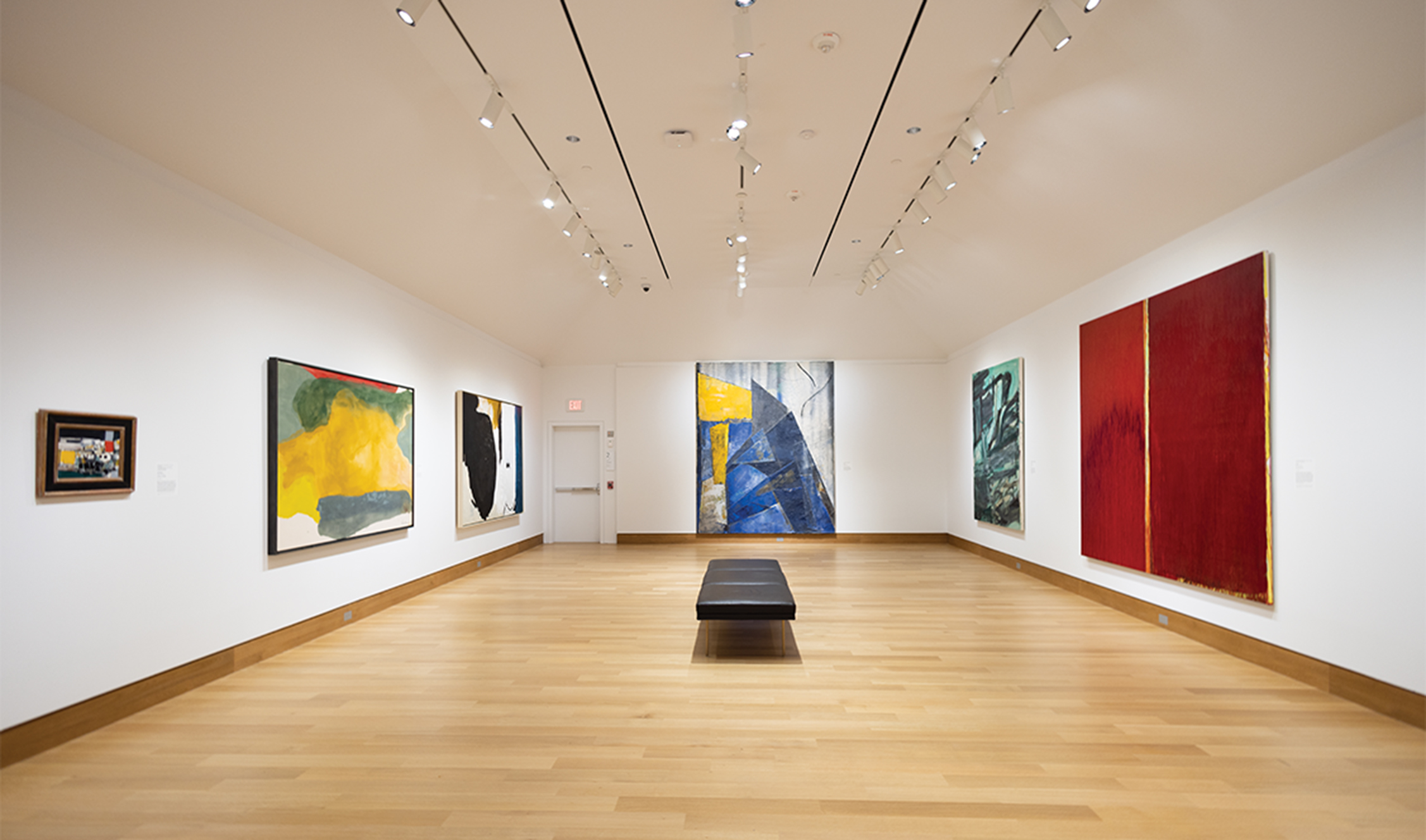
The Painter’s Hand: U.S. Abstraction Since 1950 (2023), curated by Stomberg, showcased the rich variety of American abstraction. For some abstract painters, creating a brushstroke itself has a singular importance, and the art tracks the movements of their hands, arms, and even bodies. At the same time, other artists seek to downplay or eliminate all traces of their gestures, using techniques that involve pouring, dripping or splashing pigments onto canvas.
Cara Romero: Panûpünüwügai (Living Light) (2025) explored the narrative artistic practice of photographer Romero, a member of the Chemehuevi tribe of California. The exhibition presented a thematic examination of her complex and layered images, which celebrate the multiplicity, beauty, and resilience of Native American and Indigenous experiences. The exhibit was curated by Jami Powell.
This Land: American Engagement with the Natural World (2022) highlighted responses to the natural world by diverse American artists from the early 19th century to the present. Curated by Barbara MacAdam, Jami Powell, Thomas Price, Morgan Freeman, and Michael Hartman, it was the first major installation of the museum’s historic American collection to be organized thematically, rather than chronologically. It featured for the first time traditional and contemporary Native American works alongside early to contemporary American art in a show that filled four galleries.
Chirs Quirk is a regular contributor to DAM who wrote “In the Face of Depression” (May/June 2025) and “For the Birds” (July/August 2025).