

If there’s a goal that best encapsulates the type of season Dartmouth men’s hockey has had, it likely came Friday, March 13. In the Big Green’s ECAC quarterfinal against Colgate, C.J. Foley ’27 collected the puck, spun free of a Colgate defender, then slipped it back to Hayden Stavroff ’28. Stavroff pulled three defenders and the Raiders’ goalie out of position before sliding a pass across the crease to Hank Cleaves ’28, who needed only to chip it in.
The Big Green, ranked ninth nationally, went on to beat Colgate, 4-1, on Friday and Saturday, March 13-14, to clinch a trip to Lake Placid, New York, for the conference semifinals. Later this month, the team will likely play in the NCAA tournament for the first time since 1980. Dartmouth will arrive prepared with Stavroff, Cleaves, and Foley, all nominees for the Hobey Baker Award, given annually to the top NCAA men’s ice hockey player. Stavroff, who leads the country in goals and was named ECAC Player of the Year, is closing in on leading the team in assists, too.
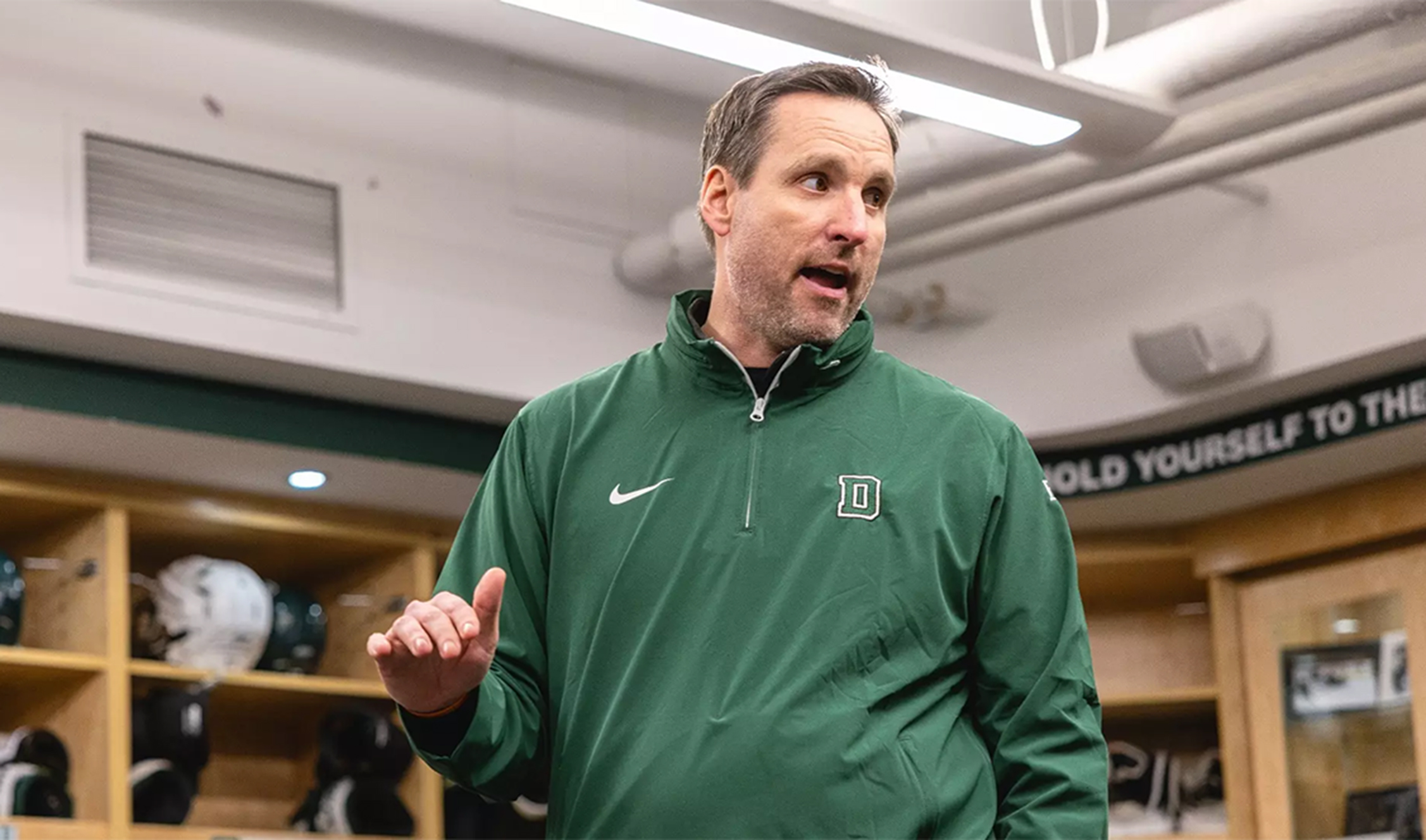
“I think they all equally just want team success,” says head coach Reid Cashman, the ECAC Coach of the Year, whose recruiting and player development has led to a Big Green resurgence.
For the first time in nearly a half-century, the Big Green has a win percentage above .700. The team finished the regular season 19-7-4, a far cry from the 5-24-1 record three seasons ago, just about the worst in the country. In his fifth season, Cashman has lifted Dartmouth from the bottom of the ECAC to tied second with Cornell, just below Quinnipiac—where he played two decades ago.
“There’s greatness that comes out of this place,” Cashman says, “and we want hockey to be a part of that.”
Because the bulk of recruiting happens two seasons out, today’s players committed to a College program that was not good. It required recruits to buy into Cashman’s plans. “We were not selling our results,” he admits. “We were selling a vision.”
As a sophomore in 2004, Cashman and his Quinnipiac team, not yet an ECAC member, traveled to Hanover to play Dartmouth in a sold-out Thompson Arena. “I was 21 years old, being like, ‘Oh my gosh, this is awesome and intimidating,’ ” Cashman recalls. “And what a rink—sold out for a non-rival game.”
It’s one of the reasons he wanted the job when it opened after the 2019-20 season. “This community supports hockey and has always supported hockey,” Cashman says. “But we needed to put a product in front of them.”
A key pitch Cashman made to recruits was to be the ones to right the ship. “Come to Dartmouth and be the group that turns it around,” Cashman recalls telling them. “Come be a part of the classes that do something special for the first time in a little while.”
A player such as Stavroff, who led the British Columbia Hockey League in goals his second season of junior hockey, had options. So how did Cashman, who was coaching the worst team in the country, get Stavroff to choose Dartmouth? The answer lay in transparency about opportunities: From day one, he could have a major role with the Big Green.
“We said, ‘There’s going to be an opportunity on our power play as a freshman and in our top six,’ ” Cashman says. “ ‘It’s not promised you and it’s not guaranteed—and when you get the opportunity, you need to make the most of it—but I can promise you that the opportunity is there.’ ”
It worked. “He had a vision and recruited people for a specific role,” Stavroff says. “I trusted what he was telling me. I wanted to be a part of something special, and that’s ultimately what we’re trying to do here.”
Stavroff was on the top line on February 28 when Dartmouth set a Thompson Arena attendance record in the regular season finale against Princeton. It meant just as much to the Big Green coach as it did to the star player. “To be the coach of a sold-out Thompson Arena with a Top 10 program with some of the best prospects in college hockey,” Cashman says. “I’m not content by any means, but I’m very, very proud and we are very, very proud of what Dartmouth hockey is right now.”
Development
Stavroff committed to Dartmouth with intentions to play in the NHL. It helped that Cashman spent two seasons as an assistant coach with the Washington Capitals.
As a head coach, Cashman says, one of his major jobs is to develop players. Unlike other programs around the county, Dartmouth does not rely on the transfer portal. The College itself does not take many transfers, and historically only a small number have been athletes. Through Cashman’s five seasons, one player has transferred in and two out.
“I actually think it helps our recruiting,” Cashman says. “When we sit and talk with recruits, we can say, ‘We’re graduating X number of players and we’re bringing in that same amount.’ ”
Recruits buy into that, wanting to spend their four years in Hanover. Cashman says that when they commit to Dartmouth, student-athletes are choosing Big Green hockey as much as the College. As a result, the program is more akin to old-school college hockey, when opportunities for “name, image, likeness” (NIL) compensation didn’t lure players to break allegiances.
“It forces us to make our guys better and develop our players,” Cashman says. “Because the guys we have are the guys we’re gonna get. We have to develop them in-house.”
Historically, Dartmouth has been a master developer, sending dozens to the NHL. Bob Gaudet ’81, the goalie on the 1980 team who then coached Dartmouth for the 23 seasons before Cashman, is proud that talent such as Stavroff is still nurtured. “Kids can come to Dartmouth and develop to the highest level,” Gaudet says. “If they have the ability, they can go on and are well trained to be a professional.”
They are also prepared for life beyond hockey. When Big Green players are done competing, after either graduation or a stint professionally, they are ready to apply lessons from the rink to a career. Two of Gaudet’s best players, Hugh Jessiman ’06 and Grant Lewis ’07, loved Dartmouth so much they came back to Hanover after NHL careers to finish their degrees.
There’s greatness that comes out of this place.”
—Coach Cashman
An indication of the College’s continued strong support for the men’s hockey program is the 11,050-square-foot renovation of Thompson Arena underway.
Alumni support has been instrumental, too. Gaudet attended this season’s home game against Quinnipiac with Michael Choukas ’51, who is now 97. It’s fair to say Cashman has earned the support of Big Green hockey alumni, including the players Gaudet coached. “His respect for the people who had come before came out when he spoke and in his written correspondence to alums,” Gaudet says. “People who wore the uniform appreciated that and embraced him.”
Culture
Alumni are always proud of Dartmouth hockey, but, Gaudet says, it helps when the team is winning and plays a fun style of hockey. Cashman’s athletes play free and are able to create. On any given line, all players are involved—the defensemen in the offense, and the offense in the defense.
“I think it’s really important as a coach to have something that the kids enjoy playing,” Gaudet says. “They’re not so structured that you’re holding them back.”
The Big Green’s speed and ability to fly around the ice is also intimidating to opponents, he says. “When teams play against them, they must think ‘Geez, Dartmouth has seven guys on the ice,’ because they can’t ever seem to get a breath of air,” Gaudet says. “At our best, that was the type of team that I wanted to have.”
While Cashman’s style is likely influenced by his previous coaching stops, Gaudet likes that Cashman had his vision for the way Big Green hockey should be played. “He was coming in with a wealth of knowledge and his own ideas,” Gaudet says. “It wasn’t my philosophy, it wasn’t [Quinnipiac head coach] Rand Pecknold’s.”
That approach resonated with players, allowing for continuity across eras of Big Green hockey.
“Seeing that he had a vision in mind and the kind of people and players that he wanted to bring in, you could really see where he had this program going,” says team captain Tucker McRae ’26. “We knew coming in that the program was on a better trajectory.”
Although today’s players understand the history of the program, their current success is their own. Cam MacDonald ’26, who is on the top line with Stavroff, says this team is focused on the here and now. “We love and respect the history of this school, and we’re super excited for all of that,” MacDonald says, “but it’s always been about this group and just being the best team in March and April.”
Will Dehmel is a DAM editorial intern and a former sports reporting intern at The Wall Street Journal.