


It was July 1, 1776, and in Philadelphia’s hot, stuffy Pennsylvania statehouse, members of the Second Continental Congress—including Benjamin Franklin and John Adams—were discussing Thomas Jefferson’s draft of what would become the Declaration of Independence.
More than 350 miles to the north in tiny Hanover, New Hampshire, Dartmouth tutor and trustee Sylvanus Ripley, class of 1771, had less lofty concerns. Ripley had just gotten word that the northern American army was in full retreat after a failed invasion of Canada—and troops were now only 90 miles away. A British army that included Native American fighters was coming south in hot pursuit, sending a ripple of fear through the College.
Seven years after its founding, the College was still a fragile outpost. Students no longer lived in log cabins but in a clutch of unprotected buildings on the southeast corner of today’s Green. And, with founder Eleazar Wheelock away in Connecticut recovering from an illness, his 26-year-old son-in-law, Ripley, was left to look after the College’s 58 students.
“This country is thrown into some confusion,” Ripley wrote to Wheelock on July 1. “The minds of the students begin to grow uneasy, and [they] say they are unable to study and unable to defend themselves in case of a savage invasion.”
The community had reason to fear the approaching Americans, too—even though alumni such as Ebenezer Mattoon, class of 1776, were among the soldiers. The army was suffering an epidemic of smallpox, perhaps the most dread disease of the 18th century, and Dartmouth was desperate to avoid an outbreak. Wheelock had once cancelled a fundraising trip to London because he considered the city a cesspool of infection. Now, people carrying smallpox were heading toward his college.
Students and faculty had plenty to worry about—including the sometimes ornery hogs that roamed the Green. Colin Calloway, professor of history and Native American studies, says they were most fearful of the Native Americans, many of them resentful about the flood of settlers coming into lands they had occupied for centuries.
“The real concern for Dartmouth and other places up here was in a sense the memories of the French and Indian War, when Native people in alliance with the French had raided down the valley, striking Massachusetts primarily,” explains Calloway. That war had ended in 1763. “The fear now,” he says, “was that history would repeat itself.”
There was real support for the Patriot cause in what is now known as the Upper Valley—militias trained on the Dartmouth Green, and Ripley himself was a pastor to the American troops—but northern New England was then the frontier of America and vastly different from cities such as Philadelphia, New York, and Boston, where the revolutionary fervor was strongest. At a time when it could take a week of hard travel over wilderness roads to reach Dartmouth from the coast, people of the frontier knew they were largely on their own. Issues of survival came first.
The minds of the students begin to grow uneasy, and [they] say they are unable to study and unable to defend themselves.” —Sylvanus Ripley
In July 1776, it was by no means clear that the Americans would prevail.
“July 4 is still very early days in the revolution. People don’t know what is going to happen,” says Calloway.
In 1776, the city of Boston—home to revolutionary rabble-rousers such as Sam Adams—was nearly 150 years old. By contrast, the towns of the Upper Valley were brand new, as the land had only become available at the end of the French and Indian War. The first permanent European settlers came to Hanover in 1765, just five years before Wheelock arrived to build his college.
What is now the Dartmouth Green was then a forest of virgin white pines more than 200 feet tall. Wheelock, aided by a crew of 30 workers, and at least seven enslaved people, who traveled from Connecticut with him, had to clear the land and build the log huts where he and his students would live that first winter. And they couldn’t expect local people to pitch in: The nearest neighbor was 2.5 miles away.
Just five years later—as the first battles of the American Revolution unfolded at Lexington and Concord, Massachusetts—Hanover had blossomed into a small community centered on Dartmouth. The Wheelock family had a house located roughly where Reed Hall is today, and the students now lived in two permanent buildings, the two-story College Hall and Commons Hall, both on the Green. Dartmouth was just a short walk to Captain Aaron Storrs’ tavern and the village of Hanover, which was established enough to have its own doctor.
But Hanover was still rough country. The Green, so symmetrical and flat today, sloped downward, and it was dotted with enormous stumps. Cows grazed freely on the Green, while elected officials called “hog howards” tried to keep the free-ranging domestic hogs out—with mixed success.
Though the early action in the war was far away in Massachusetts, people in the Upper Valley swore they could hear the fighting. Wheelock wrote in his diary on June 17, 1775, that people could hear the “noise of cannon” from the Battle of Bunker Hill—125 miles away. Although the claim seems implausible, Wheelock wasn’t the only one to make it—Moses Herbert of nearby Lebanon claimed to hear the explosions while he was shingling his roof. At a minimum, the claim suggests the Upper Valley was normally a very quiet place.
Calloway says that public opinion in Hanover about the revolution was probably a lot like that in the rest of the colonies—sharply divided. “I suspect what John Adams said probably applies here,” says Calloway. “He said about a third of the people were for the revolution, about a third were against it, and about a third didn’t care one way or another.”
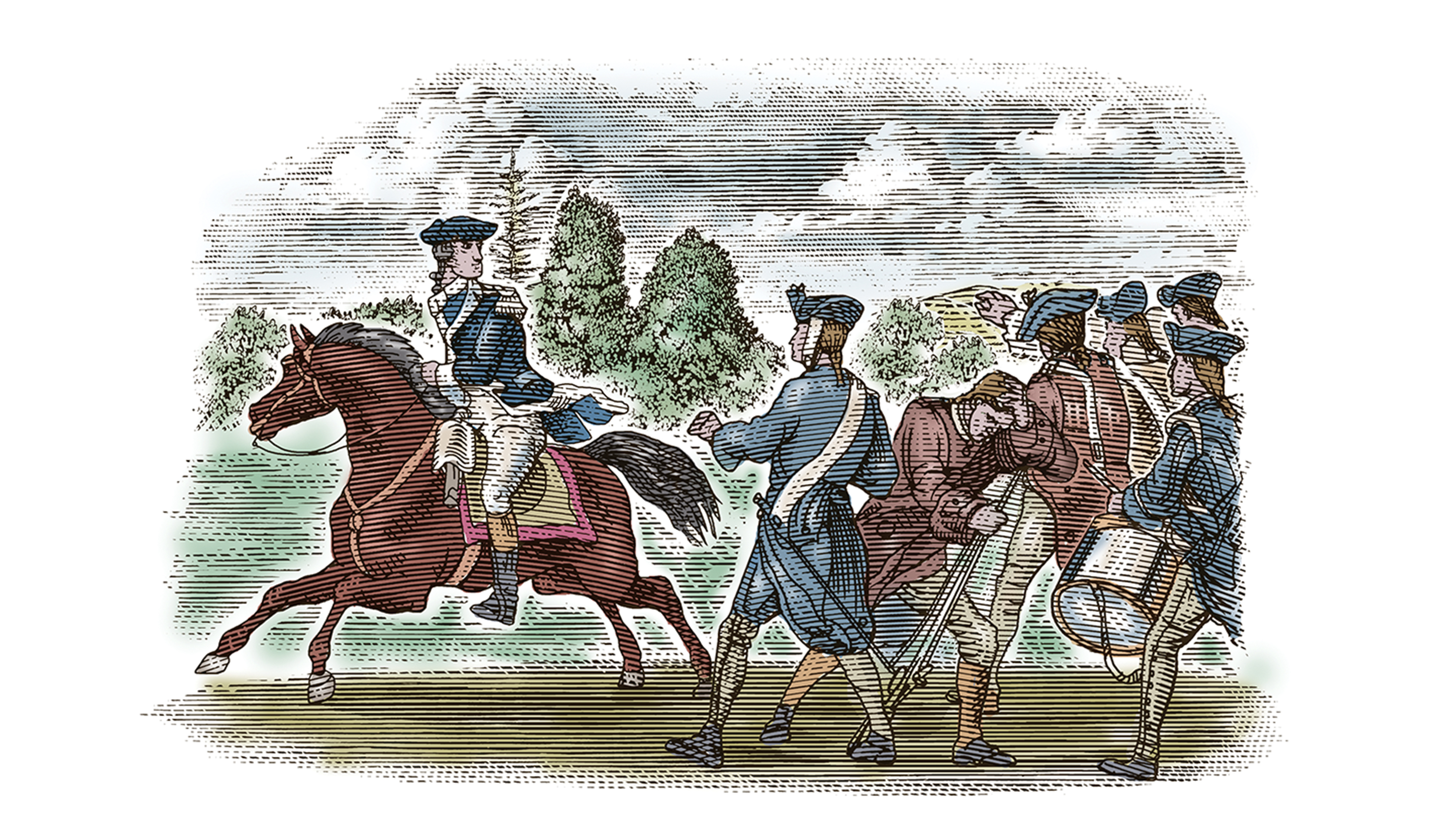
Most communities in the Upper Valley had committees of safety that kept the Patriot militias informed while keeping an eye on—and harassing—Loyalists. In April 1776, all males in Norwich 21 and older were asked to sign a pledge to “do the utmost in our power at the risk of our lives and fortunes to oppose with arms the hostile proceedings of the British against the United Colonies.” No one refused to sign.
But support was far from universal. John Ledyard, class of 1777, the adventurer who became Dartmouth’s most famous early dropout, left college in 1773 and later joined the British military. On July 4, 1776, he was a British Royal Marine in London preparing to set sail on a voyage of exploration with Capt. James Cook. Ledyard made clear he was joining the British Marines for the adventure and insisted he would not take up arms against Americans, but clearly he saw no stigma in joining the British armed forces a month before war broke out here.
There was also a sizable group in the Upper Valley that had little use for the Patriots or the Loyalists. To them, the new colonial government in New Hampshire served the interests of the coastal elites and provided little benefit to people on the frontier. In July 1776, men from Hanover and 16 other western New Hampshire towns petitioned other communities in the state with a list of grievances, arguing that the revolution’s aims were no different than those of the royal government. “This new mode of government is a little horn, growing up in the place where the other was broken off,” they wrote.
For a few years during the war, Hanover was renamed Dresden and seceded from New Hampshire, joining Vermont along with other western New Hampshire towns. But the Continental Congress never recognized the secession, and in the early 1780s the secessionists eventually rejoined New Hampshire at the insistence of Gen. George Washington.
For his part, Wheelock sided with the Americans, but some neighbors suspected him of self-serving motives. In January 1776, the committees of safety in Hanover and Lebanon investigated Wheelock for allegedly showing “unfriendly feeling” toward the revolution because he didn’t want Dartmouth to celebrate Thanksgiving on the day designated by the New Hampshire legislature. They found no wrongdoing by Wheelock—just disrespect—but the investigation spoke to the communities’ distrust of him.
However, Washington knew how valuable Wheelock could be in a region where thousands of Native Americans still lived—sometimes uneasily—alongside colonial settlers. Wheelock was running a college that offered education to Native Americans—though only a tiny handful graduated—and was in constant contact with tribal leaders. His son-in-law Ripley sometimes went on monthslong trips into Native territory to recruit students. One of Washington’s first acts when he assumed leadership of the Continental Army in June 1775 was to send emissaries to persuade Wheelock to put his Native American contacts to work for the Americans.
Wheelock agreed to help, and he persuaded the Continental Congress that Dartmouth itself was a valuable tool to prevent war with the Native Americans. “His argument was that a lot of the Indian students who were here were actually from the North,” says Calloway, “and as long as they were still in school, their parents would be disinclined to come down the valley and burn the school.” Congress even agreed to provide funding to keep the College operating.
In the end, Wheelock delivered for the revolutionaries, encouraging an early Dartmouth grad and adopted member of the Oneida tribe to serve as an interpreter and Indian agent for the American army. The interpreter, James Dean, class of 1773, helped convince the Oneida to side with the colonies.
Unfortunately for the Americans, several other tribes—all part of the powerful Iroquois Confederacy—sided with the British, largely in hopes of slowing the spread of European settlements on their ancestral lands. On July 1, 1776, warriors from the Mohawk, Seneca, Cayuga, and Onondaga tribes were heading south with Gen. John Burgoyne’s British army in pursuit of the retreating Americans.
The American army that straggled into Crown Point, New York, on July 1, 1776, had endured many hardships, including a crushing defeat in Quebec City where its leader, Gen. Richard Montgomery, was killed. The soldiers were malnourished and demoralized and beset by the smallpox that had become endemic in the region’s Indigenous populations.
Days before he got word of the army’s approach, Ripley had been quite serene about the state of Dartmouth, writing to his father-in-law on June 19 that everything was “peaceable, orderly and regular.” Ripley told Wheelock that everyone at Dartmouth rejoiced to hear his health was improving and was eager for him to return to the College.
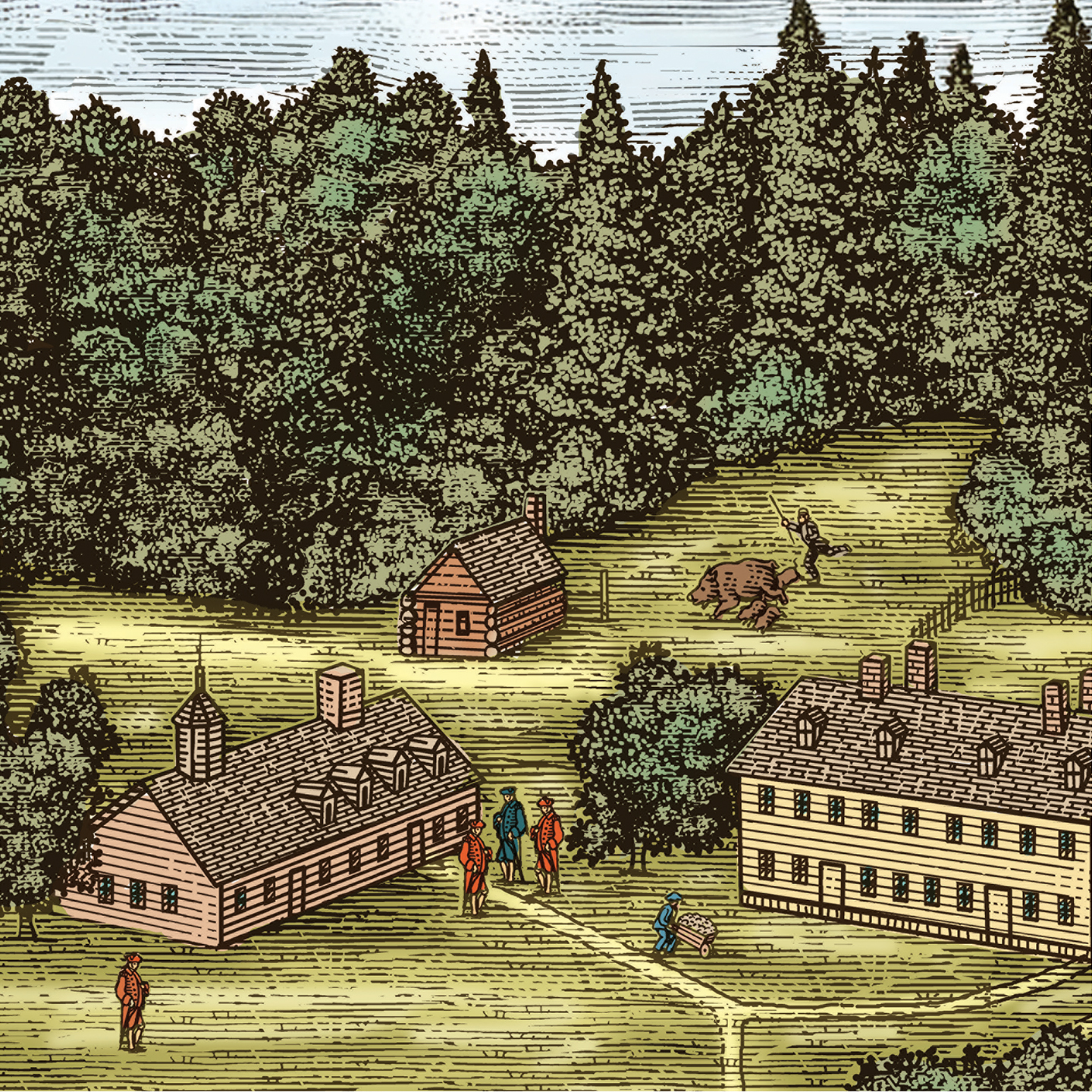
Less than two weeks later, Ripley wrote with great concern to his father-in-law: “We have news that our northern army has retreated from St. Johns [Canada], and part of them arrived at Crown Point, so that this country is thrown into some confusion.”
The next day, committees of safety from many Upper Valley towns sent an appeal to the Continental Congress. They had no idea that the Declaration of Independence was about to be signed but knew they were largely defenseless, and they asked for a supply of arms and ammunition as well as troops.
“Being exposed to the incursions of the savages and other enemies be as speedy as possible to afford us relief,” the committees wrote.
Some settlers weren’t waiting. John Slapter of Norwich decided to send his wife and two young children south to her parents’ home in Connecticut. He wrote in his journal on July 5 that they were “driven off by the fear of Indians.”
As it turned out, neither the American nor the British army ever got any closer, heading down the Hudson River Valley in New York, where, in October 1777, the Americans defeated the British at Saratoga and Gen. Burgoyne surrendered his entire army. Native warriors did kill some civilians—the scalping of Jane McCrea in New York in 1777 became a major flashpoint as well as a famous painting—but not in the Upper Valley.
We have news that our northern army has retreated from St. Johns [Canada], and part of them arrived at Crown Point [New York], so that this country is thrown into some confusion.” —Sylvanus Ripley
Late on the morning of July 4, 1776, the Second Continental Congress officially adopted the Declaration of Independence. The country did not know until four days later, when the first public reading of the document in Philadelphia announced that the Americans planned to break permanently from Britain. At some point in the days after July 8, word reached the campus.
By then, Ripley was going about the business of life. One day after the worried letter to his father-in-law, he paid a carpenter named Daniel Clap to build a cradle, likely for Ripley’s infant son John Phillips, the first of his six children, later class of 1791. On July 4, Wheelock wrote to another son-in-law, tutor and trustee Bezaleel Woodward, saying that Dartmouth should hold Commencement early, thanks to “the situation of our public affairs.” By July 25, the board of trustees shut down the College for six weeks, allowing the students to join the fight or escape the war altogether.
Additional research by Sue Shock and Kent Friel ’26