


In February, the U.S. Supreme Court dismissed the bulk of President Trump’s controversial tariffs, ruling that he didn’t have the power to use the International Emergency Economic Powers Act to impose the taxes on foreign goods. Neal Kumar Katyal, the lawyer who led the case against the government, says the 6-3 decision represented “a watershed moment” for the court—and for the country.
“This case has always been about the presidency, not any one president,” he says. “It’s about the separation of powers. It was so important to see our Supreme Court protect fundamental values that have been the bedrock of our government for 250 years.”
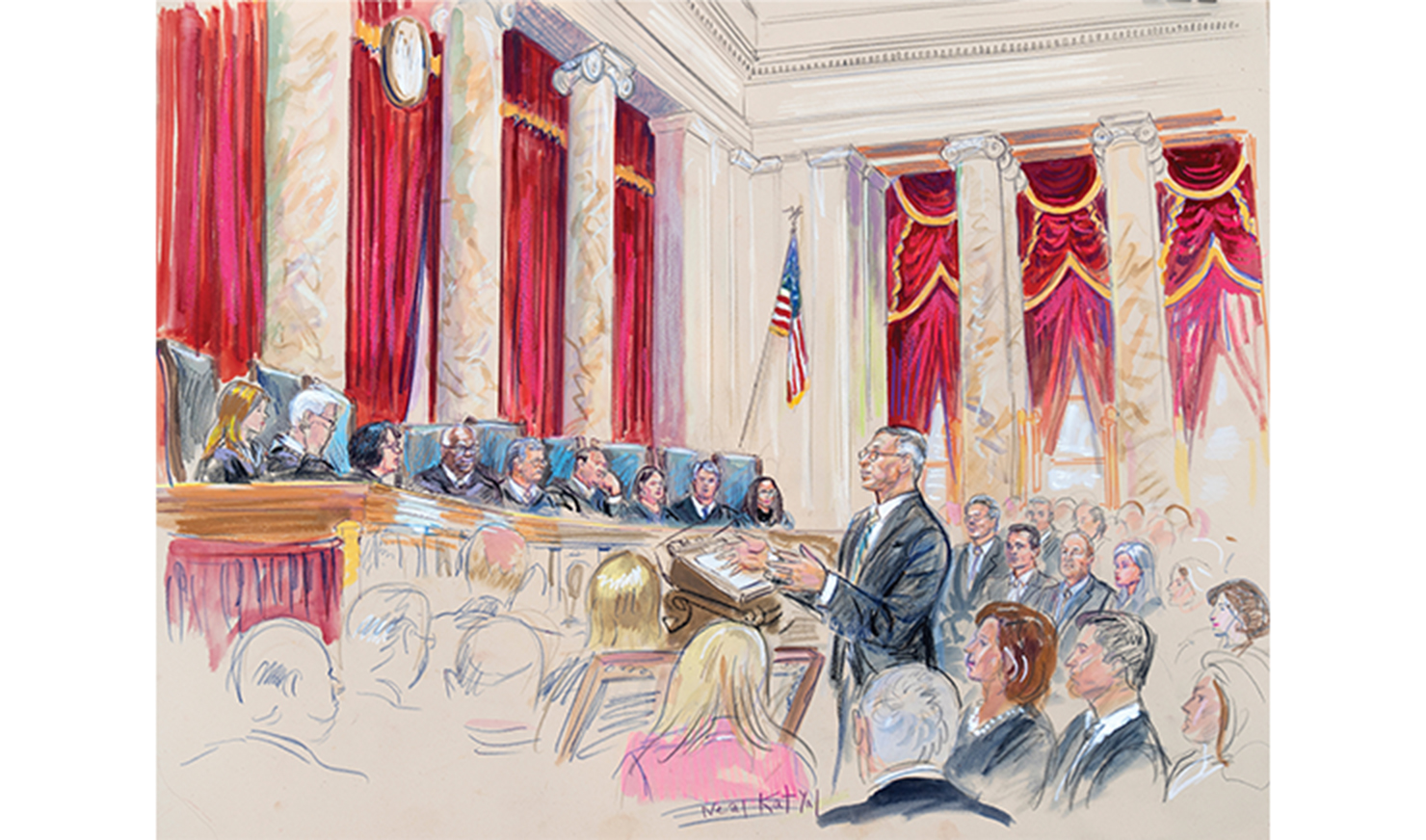
Katyal first took part in the legal battle against Trump’s unilateral tariffs in June 2025, when a U.S. appeals court considered a challenge from five small businesses led by wine and liquor distributor V.O.S. Selections Inc. In November, Katyal litigated the case at the Supreme Court, winning a coin toss with another lawyer who represented a similar defendant, a toymaker that also had sued the administration over the tariffs. Katyal argued that the emergency statute “doesn’t mention tariffs whatsoever.” The court agreed.
It was Katyal’s 53rd time arguing before the Supreme Court. He’s since made a 54th, a record for a minority attorney that surpasses Thurgood Marshall’s 32. And it was another win among the far-reaching string of legal victories he has racked up during the past few decades.
A partner at Milbank LLP international law firm and a law professor at Georgetown University, Katyal, 56, boasts a long track record of speaking up for modern-day Davids battling Goliaths and holding power in check. His advocacy has helped ensure that human DNA will never be patentable and limited executive power at military tribunals. His name has become synonymous with defending Americans’ rights, freedoms, and way of life, and he’s openly discussed why he’s motivated to battle U.S. leaders on their policies, as in the recent tariffs skirmish. “If they are left to their own devices,” Katyal points out, “there can simply be too much greed and ambition at play.”
In a 2020 TED Talk, Katyal invoked Martin Luther King Jr.’s words to describe his career trajectory: “The arc of justice is long and bends, often slowly, but it bends so long as we bend it.” That view applies to numerous cases Katyal has argued, beginning with his first—and possibly his most heated—case before the high court. In 2006, he represented Salim Ahmed Hamdan, a citizen of Yemen who had worked as a bodyguard and chauffeur for Osama bin Laden and was charged with conspiracy to commit terrorism. The George W. Bush administration planned to try him before a military commission.
Katyal, who faced criticism for defending the alleged terrorist, argued the use of such a military commission to try detainees at Guantanamo Bay would violate the Uniform Code of Military Justice and the Geneva Conventions ratified by the United States. In a 5-3 decision, the Supreme Court agreed with Katyal. Hamdan’s charges were later dropped as well, as the court noted he had not been identified as an “enemy combatant.”
So began Katyal’s lifelong pursuit to hold power accountable. The case he deems “the most important” is the landmark 2013 Supreme Court case known as Association for Molecular Pathology v. Myriad Genetics, which focused on how California-based biotech firm Myriad Genetics discovered the precise location and sequence of two genes, BRCA1 and BRCA2, whose mutations are linked to an increased risk of breast and ovarian cancer.
Because Myriad found these genes, it was granted patents on them. Any doctors or patients who wanted to know if someone had the BRCA mutation were required to use Myriad’s test, which was expensive, in part due to the lack of competition.
“It comes down to the question of whether a business can patent a human gene,” Katyal explains, “and I was flabbergasted by the use of patent law here.” He laughs briefly. “Many folks in biotech were calling for my head in this case.”
The Supreme Court granted him another win, this time with a resounding 9-0 decision. “As technical as all of it may sound, the decision may have the most profound consequences of anything I’ve done, and it’s something I’m most proud of,” Katyal says.
Because of that decision and others, he reaped an enormous number of professional accolades. The American Lawyer named Katyal “Litigator of the Year” in 2017 and 2023, and Forbes magazine listed him in 2024 as one of the top 200 lawyers in the United States. From 2022 to 2024, Washingtonian magazine singled him out as one of the 500 most influential people in Washington.
Katyal credits the road to such success to his father, an engineer, and his mother, a pediatrician, who both emigrated to Chicago from India a year before he was born. Katyal says his father had just $8 when he arrived in this country and recalls both parents worked tirelessly to give him an excellent education.
At Dartmouth, Katyal majored in government and Asian studies and, inspired by his high school debating experience, joined the debate team. He recalls how one professor’s comment redirected his career path. “When history professor Doug Haynes saw me debate, he said I was so good at arguing my point I should be a lawyer, and that’s when I took that detour,” says Katyal, who is married to a physician and is the father of three, including a ’24 and ’28. An active alum, he has served on the College’s board of trustees for the past five years.
After graduating, he sought a law degree at Yale. Akhil Reed Amar, one of Katyal’s professors there, saw something special in the student. “I remember Neal being eager and enthusiastic and so hard-working, and he has a very good attitude and is a good listener,” Amar says. “He can anticipate the next question. He also gets along well with everyone. Put that all together and that’s a very strong package.”
In his final year, Katyal edited The Yale Law Journal and clerked for Judge Guido Calabresi of the Second Circuit U.S. Court of Appeals. Calabresi applauds Katyal’s intelligence and legal acumen. “He has always been able to see what the other side will be arguing and therefore find the best way to argue against it—and that’s unusual,” Calabresi says. “It’s one thing to be excellent at what you do but to also have that goodness in your heart, that humanity, that’s what makes for a successful lawyer and that’s Neal.”
Katyal, who later clerked for Supreme Court Justice Stephen Breyer, told The Washington Post he learned a lot from Breyer’s “constitutional humility” and the close attention he paid to experts in fields such as national security and the environment.
When Katyal was invited to teach at Georgetown University Law Center, he postponed the appointment for two years to join the U.S. Justice Department in 1997. As a national security advisor at the DOJ, he wrote a report for President Clinton on the need for more pro bono legal assistance by private lawyers.
Later, he was at Georgetown when President Obama nominated him to be principal deputy solicitor general, and when Obama elevated Elena Kagan to the Supreme Court in 2010, Katyal then became acting solicitor general, a position he held for 13 months until June 2011.
This case has always been about the presidency, not any one president. It’s about the separation of powers.”
—Neal Katyal
It was during that period that Katyal wrote a rare “confession of error” post on behalf of the Justice Department, acknowledging ethics lapses in its arguing of the 1942 case that led to the internment of Japanese Americans.
That statement led to what he considers one of the more meaningful moments in his life. He had been speaking at the Japanese American Citizens League in Hawaii, discussing why he came to the groundbreaking decision to issue the statement regarding false information the DOJ had provided decades earlier.
Following Japan’s 1941 attack on Pearl Harbor, the then-solicitor general had advised the White House to uproot more than 100,000 people of Japanese descent, most of them American citizens, and confine them in internment camps. Katyal’s statement, posted on the White House website, said the solicitor general at the time had learned of a key intelligence report undermining the argument behind the internment but had suppressed that evidence.
“When I spoke about that confession, that we made a huge mistake then,” Katyal says, “there was lots of crying in the audience. One woman shared she found out only recently her mother was interned at a camp, that there was so much shame in her family about it. It made me realize how it was important for the United States to set the record right, and my hope is that we never go through a period like that again.
“It didn’t make sense to me to uphold that old decision,” he adds. “I believe the government maximizes its credibility when it tells the truth.”
This belief undergirds his view that an effective litigator must be unafraid to hold anyone’s feet to the fire. “People aren’t angels,” he says, “and that’s why the courts are always necessary.”
David Silverberg, who wrote the July/August 2025 cover story, “Modern Farmer,” lives in Toronto.