


Since 1910, when the Dartmouth Outing Club hosted races at its first “field day”—an event that would later morph into Winter Carnival—Dartmouth has been a leader in cross-country ski competition. At the first Winter Olympics, held in the French Alps in 1924, Dartmouth’s John P. Carleton, class of 1922, was named a captain of the U.S. Ski Team.
Yet, for all of Dartmouth’s leadership, no student or alum has won a medal in Olympic Nordic skiing—ever.
Could the Winter Games in Milan and Cortina, Italy, this February be the place where Dartmouth finally breaks this century-long losing streak?
Rosie Brennan ’11 came the closest to doing so at the 2022 Games in Beijing, China, when she had one of the best Olympics ever for a U.S. cross-country skier. She competed in all six women’s races and came within 1.33 seconds of winning a bronze medal, finishing fourth in the sprint.
“I was probably in the best shape of my life at those Olympics and had some good races that I’m proud of,” Brennan says. “Of course, there were some bittersweet moments as well, but as a whole, it was a really good Games.”
Now 37, she is hoping to qualify for her third Olympics this winter and one more shot at that elusive medal. The climb is steep this go-round as she recovers from a mysterious illness that causes muscle fatigue, but Brennan has a history of overcoming adversity.
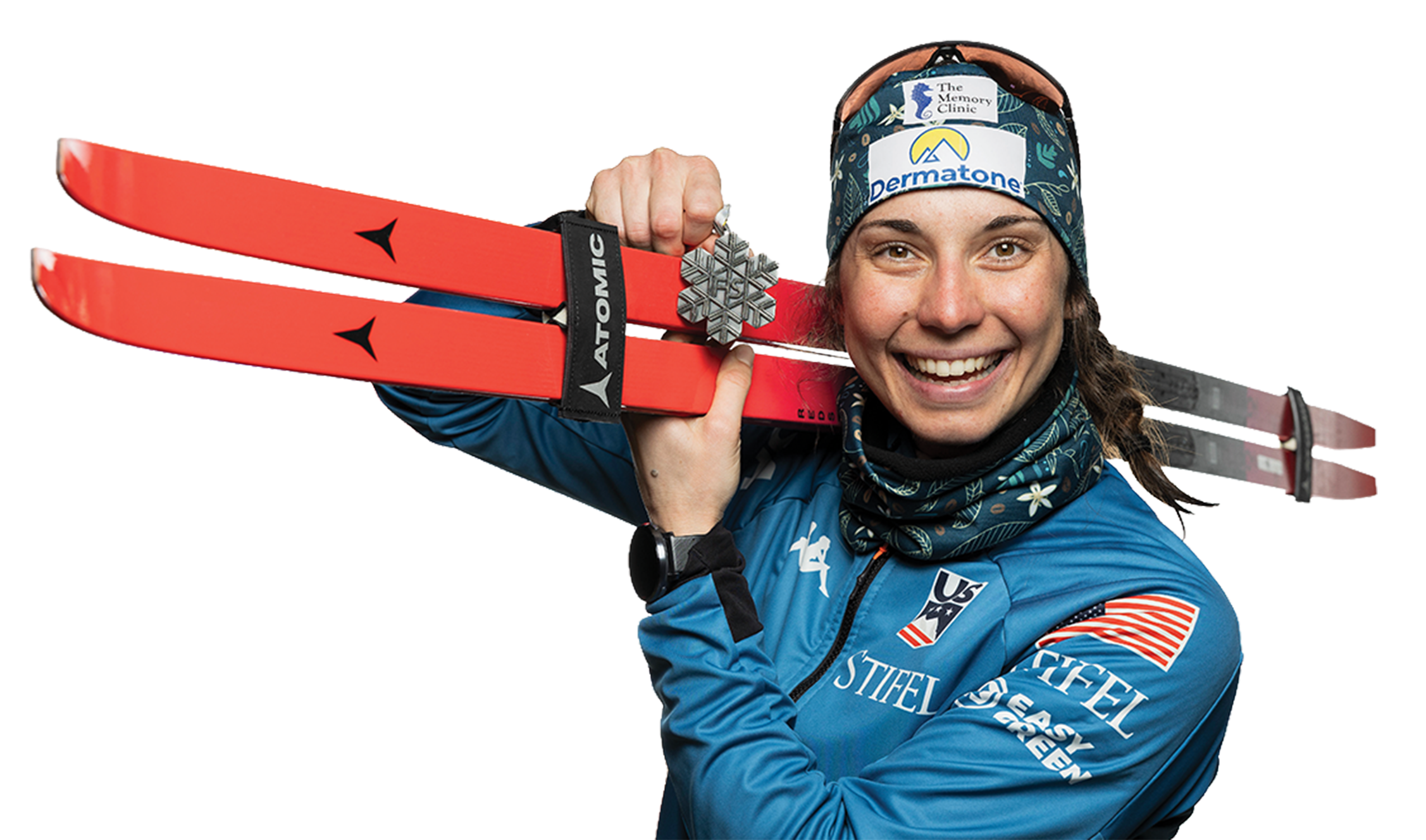
Should she qualify, she could join at least two other Dartmouth skiers with a shot at an Olympic medal. Julia Kern ’19 has generated Olympic buzz since coming in second in the women’s team sprint at the Nordic World Ski Championships in early 2025 with Jessie Diggins, America’s most decorated cross-country skier. This duo has a real chance to medal at the 2026 Olympics.
On the men’s side, Dartmouth’s best hope may be John Steel Hagenbuch ’25, who graduates in June. He hopes to make his first Olympic team this winter, when his best chance at a medal would likely come in the four-man relay.
Kern says Dartmouth skiers are part of an unusually talented U.S. Nordic team this year. “Our men’s and women’s teams have medal potential in pretty much every event,” she says. “The stars just need to align.”
A Storied History
The College’s lack of Olympic medals in Nordic skiing—which includes cross country and ski jumping—parallels the fortunes of the U.S. Ski and Biathlon teams more generally. The only ski jumping medal Americans won—a bronze in 1924—was not awarded until 50 years later to fix a scoring error. In cross-country skiing, U.S. racers did not stand on the podium until 1976, when Bill Koch claimed a silver in the men’s 30-kilometer race. That was it for the Americans until 2018, when Kikkan Randall and Diggins won gold in the women’s team sprint as the NBC commentator screamed, “Here comes Diggins!” when she surged into the lead in the final meters of the race.
Dartmouth has sent many notable athletes to the Olympic starting line in Nordic skiing—from four-time Olympian Tim Caldwell ’76 to three-time Olympian Leslie Thompson ’86, sister of current Dartmouth ski director Cami Thompson. But Dartmouth athletes only recently began to hit their stride. At Sochi, Russia, in 2014, Sophie Caldwell ’12 finished sixth in the sprint, the best Olympic finish for a U.S. female cross-country skier at the time. Other Dartmouth skiers such as Ida Sargent ’11 and Susan Dunklee ’08 have won medals in the World Cup and at world championships but not the Olympics.
And then there’s Brennan. Her fourth-place finish in the freestyle sprint in Beijing is the best by a Dartmouth cross-country skier at the Olympics—and the third best ever for a U.S. woman. Since 2022, Brennan has finished on the World Cup podium 10 times, competing at every distance and discipline from the classic kick-and-glide sprint to the 20-kilometer mass start freestyle, or skate, race.
Kern, 28, is following closely in Brennan’s tracks. She has also made the World Cup podium in the past few years and is particularly gifted in the team sprint, where two team members each race a sprint course three times, handing off to the other after each lap.
While top skiers typically go straight to the U.S. Ski Team from high school, Brennan and Kern credit Dartmouth for providing a launch pad for their careers.
Why Dartmouth?
Brennan was already on the U.S. Ski Team when she arrived in Hanover in the fall of 2007. Originally a gymnast from Park City, Utah, she discovered cross-country skiing late—in eighth grade after her mom encouraged her to try it—and quickly showed talent, winning a Junior Olympic title in 2006 and qualifying for the junior world championships. Like many elite skiers, she chose Dartmouth because, unlike other NCAA Division I universities, the College did not make her choose between the college team and international racing. Brennan could compete for both Dartmouth and the new U.S. Ski Team development team. She also liked Coach Thompson’s philosophy of supporting both the athlete and the person, not to mention the convenience of the Oak Hill Outdoor Center, which is so close to campus that she could ski to practice when there was snow.
At Dartmouth, she trained with teammates such as soon-to-be-Olympians Caldwell and Sargent, and during her four years on the Eastern Intercollegiate Ski Association Carnival circuit, Brennan finished in the top three in almost every race she entered.
“Rosie is such a tough competitor,” says Thompson. “If she decides she wants it on a given day, she really knows how to go after it.”
Brennan’s toughness has been evident throughout her career as she has battled illness, injury, and disappointment. Dropped from the U.S. team her sophomore year when the development program was discontinued, she considered quitting school to ski full time and earn her way back. Instead, she decided to stay at the College.
“I’m very thankful for that decision,” she says. “Dartmouth provided me that backbone and safety net that the U.S. Ski Team can’t provide. I had a team and coaches who believed in me immensely.”
Then, after a series of injuries senior year, she considered quitting ski racing altogether. But Thompson convinced her to ski one last season for Dartmouth in 2011. It helped Brennan rediscover her love of the sport.
“I credit Cami for giving me the space to figure out what I wanted and what I needed,” she adds. “Had I not been at Dartmouth, I would have quit. It was too hard to do it on my own. I needed that support.”
Kern had a similar journey to Dartmouth. Like Brennan, she did not start competing in cross-country ski racing until high school—after injury ended her basketball career. Growing up in Waltham, Massachusetts, she had cross-country skied while visiting her grandparents in Germany. As a high school freshman, Kern went to U.S. cross-country nationals and did so well that she earned a spot on a junior team competing in Norway. She never looked back. Two years later, she competed at the junior world championships.
After graduating from high school, Kern was named to the U.S. Ski Team and took a gap year—or rather, a few gap months during which she joined the Stratton Mountain (Vermont) School elite team alongside Diggins and other stars. When Kern started at the College the following spring, she was already deeply committed to international competition. She had chosen Dartmouth for the rigorous academics and, like Brennan, because she could continue competing with the U.S. Ski Team.
“The Dartmouth women’s team was strong, and I really liked the program, so there were a variety of reasons I chose Dartmouth,” Kern says. “The flexibility of the quarter system was the big drawing point.”
World Cup Rollercoaster
Kern never did compete in a collegiate race for Dartmouth, but she trained with the Big Green team when on campus and reveled in the camaraderie. Her international ski career quickly blossomed, and in 2017, she and three other U.S. juniors, including Dartmouth teammate Katharine Ogden ’21, made history when they won the first team relay medal ever—a bronze—for the United States at the junior world championships. That spring, Kern competed in her first World Cup in Quebec City, with green jackets and Dartmouth flags everywhere in the “crazy crowd.” It was, she says, a great introduction to World Cup racing. In December 2019, she earned her first World Cup podium—in a freestyle sprint—and a few months later won a bronze medal at the under-23 world championships, again in a freestyle sprint.
But Kern has had her share of injuries, too, to her elbow, back, and shins. To keep competing, she has learned to adjust training to what her body can withstand. As Thompson points out, “Nordic skiers don’t win by training the longest number of hours, they win by doing what’s smart and what their bodies can handle.”
Kern is smart, and after a dip in the early 2020s, her results have steadily improved. She competed in the 2022 Olympics, finishing 18th in the sprint. She has also become more adept at distance racing, competing in the 50-kilometer at the world championships last winter. Today, she can compete with the best in any individual or team sprint.
“As you get older, you just get stronger, ideally with more under your belt, and you also learn about yourself and how you train,” she says.
Brennan’s ski career, too, has been a rollercoaster ride. Since graduating from Dartmouth in 2011, she has hit incredible highs and lows, such as not making the 2014 Olympic team and, four years later, making the Olympic team but then coming down with mononucleosis. Highs have included winning her first World Cup race in a freestyle sprint in Davos, Switzerland, in December 2020, then adding another win the next day in the 10-kilometer freestyle race. She stood on the podium two more times that season and launched herself into the 2022 Olympic year.
At the Beijing Olympics, Brennan finished in the top six in four different races, including her fourth-place finish in the sprint—a result that would have earned her headlines had Diggins not medaled in front of her. Fourth place at the Olympics is often described as the toughest place to finish, leaving athletes to ponder, “If I had done something different, would I have won a medal?” But Brennan is realistic.
“I don’t know if that would have changed anything,” she says. “Maybe I would have done worse.”
Medal Chances in 2026
With two such talented skiers returning to the Winter Games, an Olympic medal for a Dartmouth cross-country skier seems a strong possibility. In fact, since the Beijing Games, Brennan has scored some of her best results at every distance.
But the strange illness that has drained Brennan’s stamina since Christmas 2024 threatens to derail her Olympic dream. While “everything indicates that I should recover,” she says, “it’s just an unknown timeline.”
“Rosie is just such an emblem for resilience,” says Kern. “She shows what it’s like to be successful and resilient and stay in the sport for a really long time, which I think has a huge impact for inspiring the next generation.”
With Brennan’s health in question, Kern presents Dartmouth’s best possibility of winning a medal—with Diggins in the team sprint. “They seem to feed off each other really well and have the ability to make it happen,” explains Thompson.
Kern, who is as positive and quick to smile as Diggins, says the team sprint format suits her well. “You punch really hard, but you get a recovery” between sprint legs, she explains. “And I have the endurance from distance racing.”
Don’t be surprised to see Kern also enter the skiathlon, a race that combines 10 kilometers of classic skiing, then 10 kilometers of skate skiing. Last year, on the 2026 Olympic course, Kern finished seventh in a World Cup skiathlon, calling that race a “confidence booster.” Then there is the women’s relay—a four-person event in which the U.S. skiers have never won an Olympic or world championship medal, though they’ve repeatedly finished fourth at worlds. Traditionally in the women’s relay, four skiers each raced 5 kilometers, although now they each ski 7.5 kilometers, the same distance as the men. Since the change to the longer distance two years ago, U.S. women have finished on the World Cup podium twice, with Kern anchoring the final leg.
The Olympic year is filled with pressure, but Kern has a solid perspective, especially having been on the stage before. “There are expectations, both internal and external,” she says. “I have something to win and something to lose, which is really a privileged and cool place to be.”
Top Male Contender
In 2019, Hagenbuch, a 24-year-old from Sun Valley, Idaho, who is likely to make the U.S. Olympic team, was part of the U.S. team that won the relay at world juniors—a historic victory. Two years ago, in a World Cup relay in Gällivare, Sweden, he skied the fastest freestyle leg of the day. Had Steel Hagenbuch been on the USA 1 relay squad (which finished fifth) instead of the second team, USA 1 would have made the podium.
“I do not want to just go to the Olympics,” he says. “I want to have really outstanding results at the Olympics.”
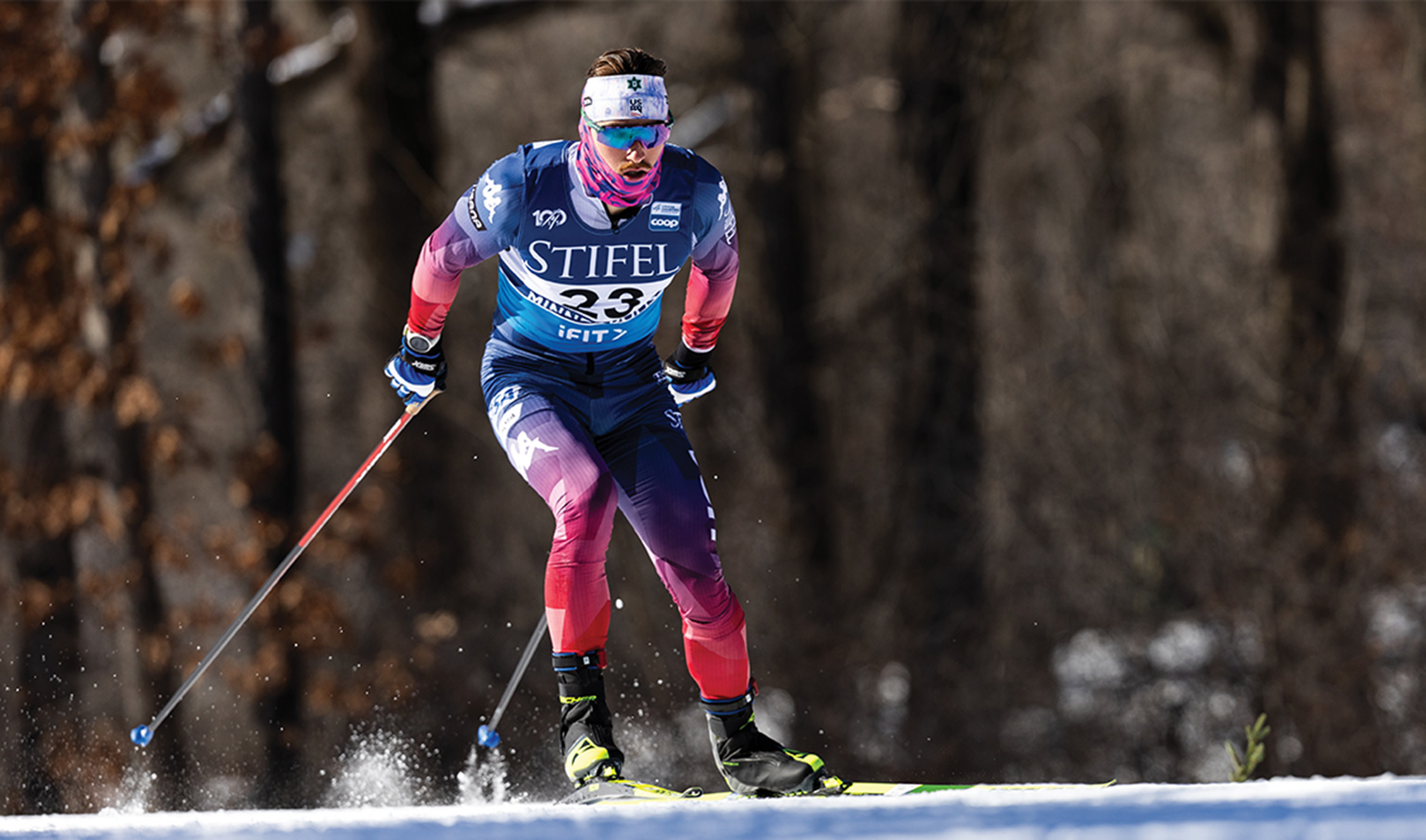
Hagenbuch took off the fall quarter to train for the 2026 Olympic season. But he will enroll for winter term, an odd schedule for someone who wants to compete at the Games for two weeks in February.
“I have a pipe dream of being able to ski at the Olympics and for Dartmouth in the same season,” he explains. “Skiing for Dartmouth has been one of the greatest privileges and blessings in my life, and it means a lot to me. I would really like to cap that off in a meaningful way.”
What does he mean by a meaningful way? Winning the NCAA team title, of course. He already has two individual titles.
But first there’s the 2026 Olympic Games in Italy, with expectations riding high. As Coach Thompson says, “We’ll be cheering loudly for all of them.”
Peggy Shinn is the author of World Class: The Making of the U.S. Women’s Cross-Country Ski Team and has covered eight Olympic Games for TeamUSA.com.
Read more:
ALPINE CONTENDERS
Dartmouth’s top alpine skiers open up about what drives them as they train for the Winter Olympics.
MORE OLYMPIC CONTENDERS
Four Olympic hopefuls pursue their winter dreams.