


Filippo Ciabatti runs upstairs above the Hop’s Spaulding Auditorium stage to hit a note on the pipe organ for the Dartmouth Handel Society orchestra to tune up. Moments later, he’s back at the podium, and Felix Mendelssohn’s Elijah begins.
He hunches, lunges forward, sways, at moments almost dances during this late April rehearsal. He sings from time to time, telling the musicians, “We need to think of the phrases as more connected—very vocal.” He strokes his baton on his hand to suggest how the bass and cello players might bow their strings. He splays his hands to evoke a crescendo. As the music resolves and quiets, his movements slow. “That was great,” he says. His back is drenched in sweat.
“I’m not minimal in my conducting,” Ciabatti says. “Conducting has a lot to do with your own physicality, your own personality. For me, it’s important to try to understand what works for the orchestra—and what feels most Filippo to me.”
Two days later, the orchestra performs the massive work with more than 70 singers from the Glee Club and Handel Society—the oldest “town and gown” amateur choral society in the country. Vocal coach Erma Mellinger, the College’s assistant conductor for choral ensembles, says Ciabatti “knows what he wants but works with people in a way that’s very respectful. His conducting style spurs the singers—both the students and Handel Society members—to respond. For the audience, it’s just beautiful to watch.”
One week later, Ciabatti rehearses the Dartmouth Symphony Orchestra (DSO) for Igor Stravinsky’s Firebird, an orchestral concert and ballet work to be performed that weekend in a live simulcast with dancers in the Hop’s Daryl Roth Studio Theater.
Ciabatti matches his moves with the music he wants the orchestra to create: When it sounds like the fluttering of wings, he flaps his arms. There’s an urgency at times in this haunting music. It shimmers, then suddenly the mood changes, building to a fever pitch that sounds like shattering glass, before it swirls back to calm. At one moment, he accidentally sends his baton flying. During a second run-through, he urges the violinists to create a mild crescendo “so you can hear all the flowering.” He breaks into a big smile when the musicians do just that.
Firebird is “quite the monster to put together,” says cellist Ava Rosenbaum ’26, a section leader who played for the DSO all four years. An electrical engineering major headed for a job in aerospace engineering in California after graduation, she describes Ciabatti’s conducting style as “very expressive.”
Lucca Radosavljevic ’28, a bass player from Brazil majoring in mechanical engineering, says Ciabatti “can be intimidating at times, but he’s really clear.” Echoing Mellinger, he adds, “He’s very respectful.”
“I’ve never seen someone move so much,” adds harpist Greta Richardson ’26, who plans to apply to medical school. “He’s super dynamic, but he still gives you the beat. He’s easier to follow than a lot of other conductors.”
Ciabatti, who received the 2021 American Prize in Conducting, relishes the commitment among the singers and musicians: “The students in the ensemble are there because they really want to do it. Almost no one is getting class credit and very few are music majors. They are going to go into engineering or being doctors, but they want to keep music in their lives.
“We want these people to rule the future of our world. And I think music is a very important part of this. Our mission is to get these kids to understand the importance of hard work, of community, of listening, of taking a step back to help another person, the importance of the arts in general and of beauty in your life.”
The musicians understand how he literally embodies the music.”
—Allan Wieman
Ciabatti, 39, who recently marked a decade as director of orchestral and choral activities at Dartmouth, grew up in Florence, Italy, and started to play piano at age 5 1/2, taught by Massimo Niccolai, a conductor who remains his mentor.
“When I was about 10, my teacher brought me to a concert,” Ciabatti recalls. “I remember very vividly this concert—who was playing and what they were playing. I came out of that concert with a huge impression that I wanted to do this: conduct. There was something very magical about the person governing all the sound and helping the music grow and come to life. The piano is a very solitary instrument. Being able to play together in this shared sense of humanity was very appealing.”
Still, Ciabatti continued to study the piano. “My teacher was adamant: You become a great instrumentalist first. You can’t stand in front of other musicians if you’re not an accomplished musician.” By age 16, Ciabatti was playing piano for professional singers and conducting a choir at church.
Ciabatti lives in Windsor, Vermont, with his wife, Francesca—who works in public health since earning a master’s degree at Dartmouth—and son Gianluca.
In addition to his work at the College, Ciabatti conducts extensively elsewhere. He is the artistic director of Upper Valley Baroque, a professional ensemble he cofounded that is starting its sixth season this fall. In April he was appointed principal guest conductor of Boston Baroque, after serving as its assistant conductor since 2023. He is music director of the Opera Company of Middlebury, where in May he conducted Verdi’s La Traviata. In July he conducted Mozart’s comic opera Cosi fan Tutte at the Seagle Festival in the Adirondacks. He also has conducted numerous operas at the Lyric Theatre of Illinois and Opera North in New Hampshire. “The landscape he covers is pretty broad and remarkable,” says Mellinger, “but he seems to be able to juggle everything, and he does it all well.”
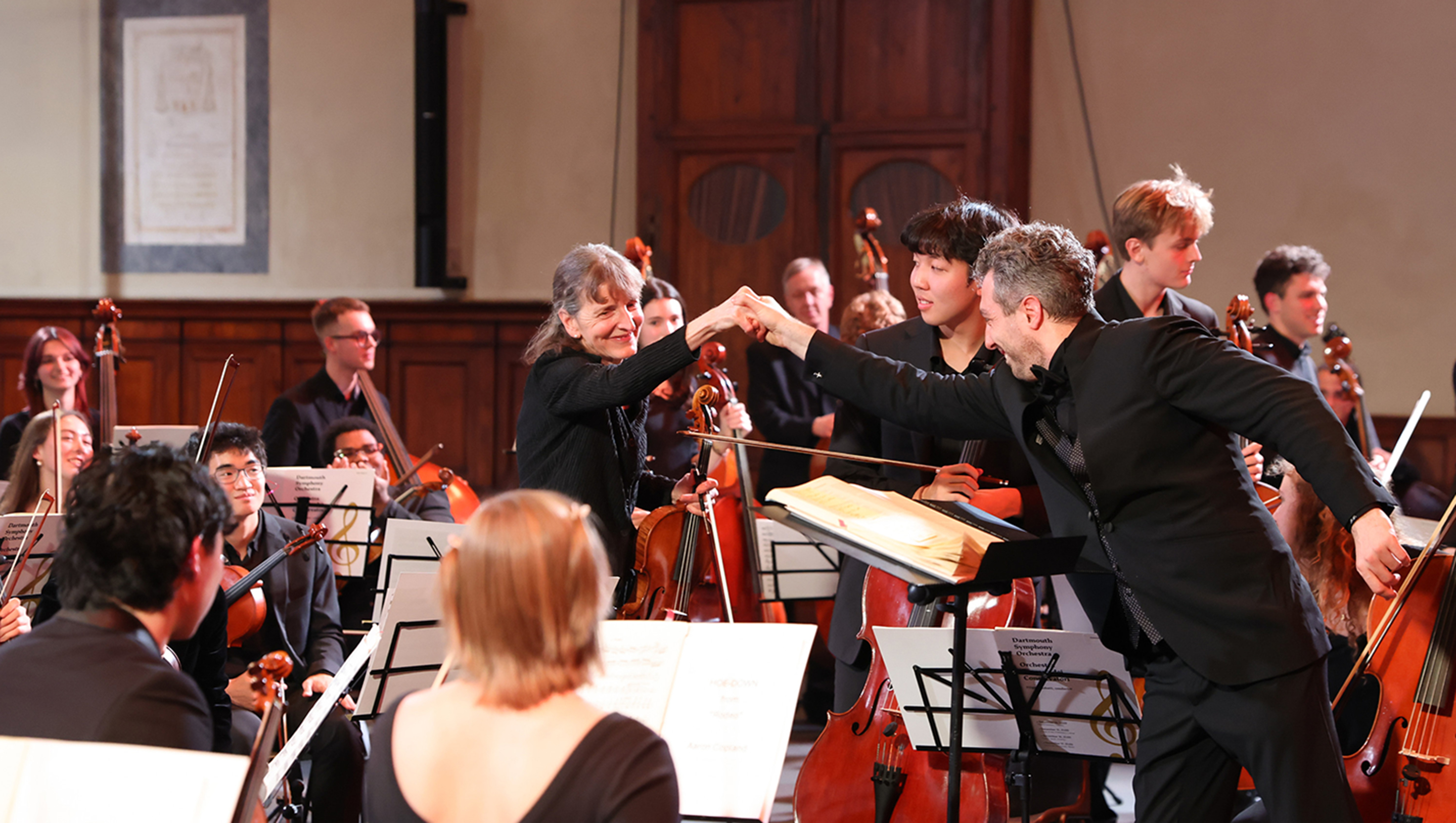
Marcia Cassidy, a viola player, often performs with Upper Valley Baroque and Opera North. At Dartmouth since 1997 as the orchestra’s assistant conductor, she urged the 2015 search committee seeking a new conductor to consider Ciabatti. “He knows what musicians need,” she says. “He puts his foot on the podium and within 30 seconds, we’re all at the ready, because he commands that.”
During Covid, when singing was considered a high-risk activity, Ciabatti organized Handel Society rehearsals in parking lots, with members singing their parts through FM transmitters in cars. Baroque music singers Jo Shute and Allan Wieman, who were members of the Handel Society, were impressed by Ciabatti’s resourcefulness.
“We wondered whether he might be interested in taking on yet another ensemble,” says Shute, referring to their plans to start Upper Valley Baroque. Ciabatti joined them and suggested that they make the ensemble all professional so that they could draw on musicians from around the country who play period instruments. Covid turned out to be a lucky break, she says: “All these professionals’ gigs had been cancelled. Once they experienced working with Filippo, they wanted to keep coming back.”
Violinist Susanna Ogata, who has performed with Upper Valley Baroque since its first season and was recently named first concertmaster, agrees that Ciabatti is a major draw. “He fosters a warmth and a spirit of collaboration,” she says. “The music-making ends up being free and generous. That resonates with me.”
Wieman says Ciabatti’s rehearsals “are well-planned, and it’s a sign of his respect for the musicians and the music. The musicians understand how he literally embodies the music.”