


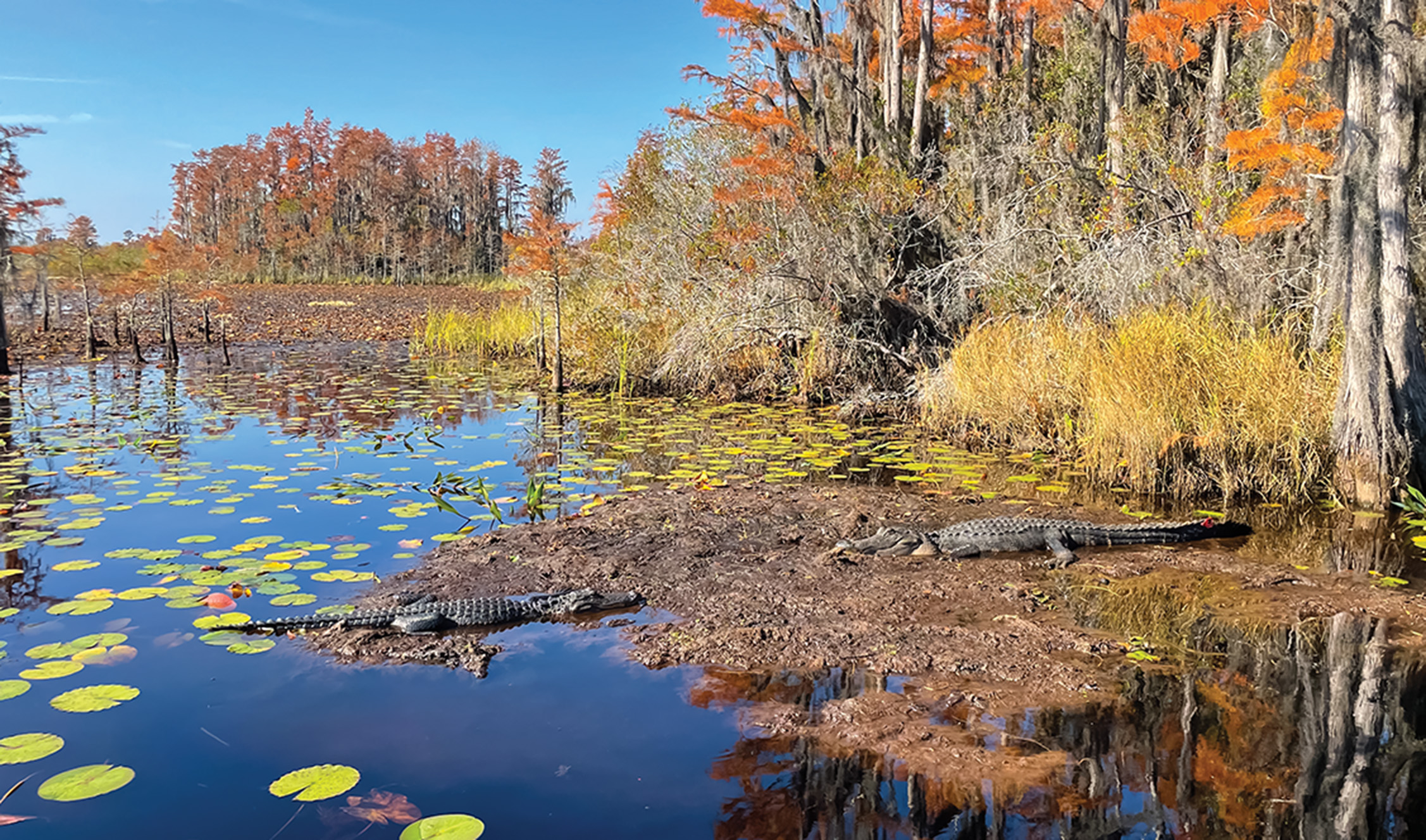
It was probably 9 p.m. when I finally lay down on the wooden platform in the middle of the swamp, exhausted from a 10-hour workday. Above me was the greatest sea of stars I had ever seen, but something else caught my eye. About 10 feet away in the black water below were two pairs of orange orbs that would stare at me for the next two hours, without moving an inch.
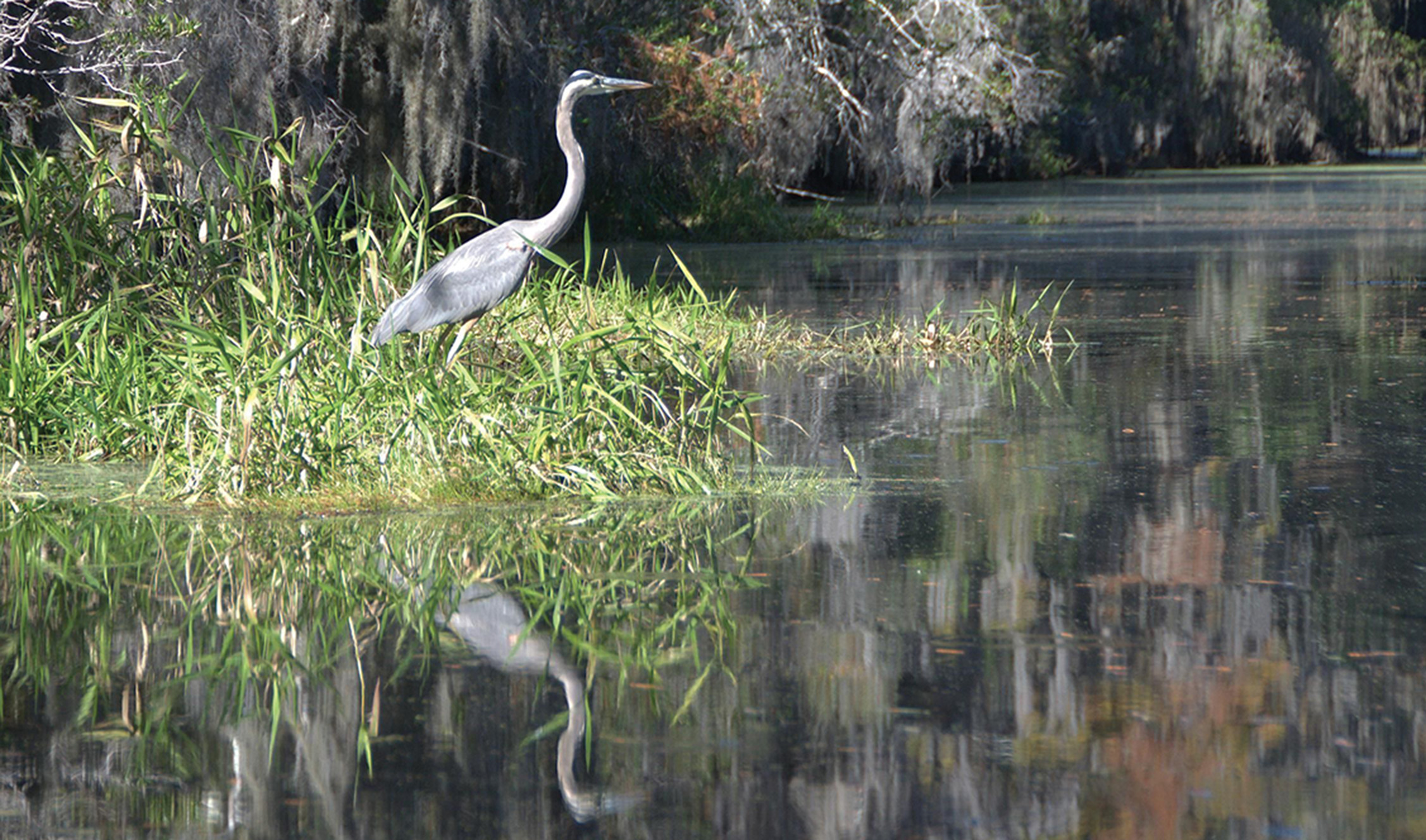
It was 1997, and I was part of a volunteer maintenance crew whose mission was to clear overgrown vegetation blocking the canoe trails that are the only way to traverse the Okefenokee Swamp in southern Georgia. Lily pads, cypress trees, and tea-colored water stretched as far as the eye could see, while sandhill cranes and snowy egrets circled overhead. The only human sound was our canoe paddles hitting the water. It felt like I’d been transported back to a primordial era before humans upended the ecological balance of things. If a dinosaur had come round the bend, I wouldn’t have been shocked.
Turns out those orange orbs belonged to two very large alligators, which were probably hoping that one of us might sleepwalk or roll into the water. So much for sleeping out under the stars; I went inside the tent, made sure it was fully zipped, and hoped for the best. When most people think of this country’s great wild places, names that usually come to mind are Yosemite, Yellowstone, or the Grand Canyon—enormous, iconic landscapes that look like 3D artwork. Swamps don’t usually make the list.
When most people hear the word “swamp” they think mosquitos, malaria, and snakes—or politicians promising to drain the proverbial swamp that is Washington, D.C.
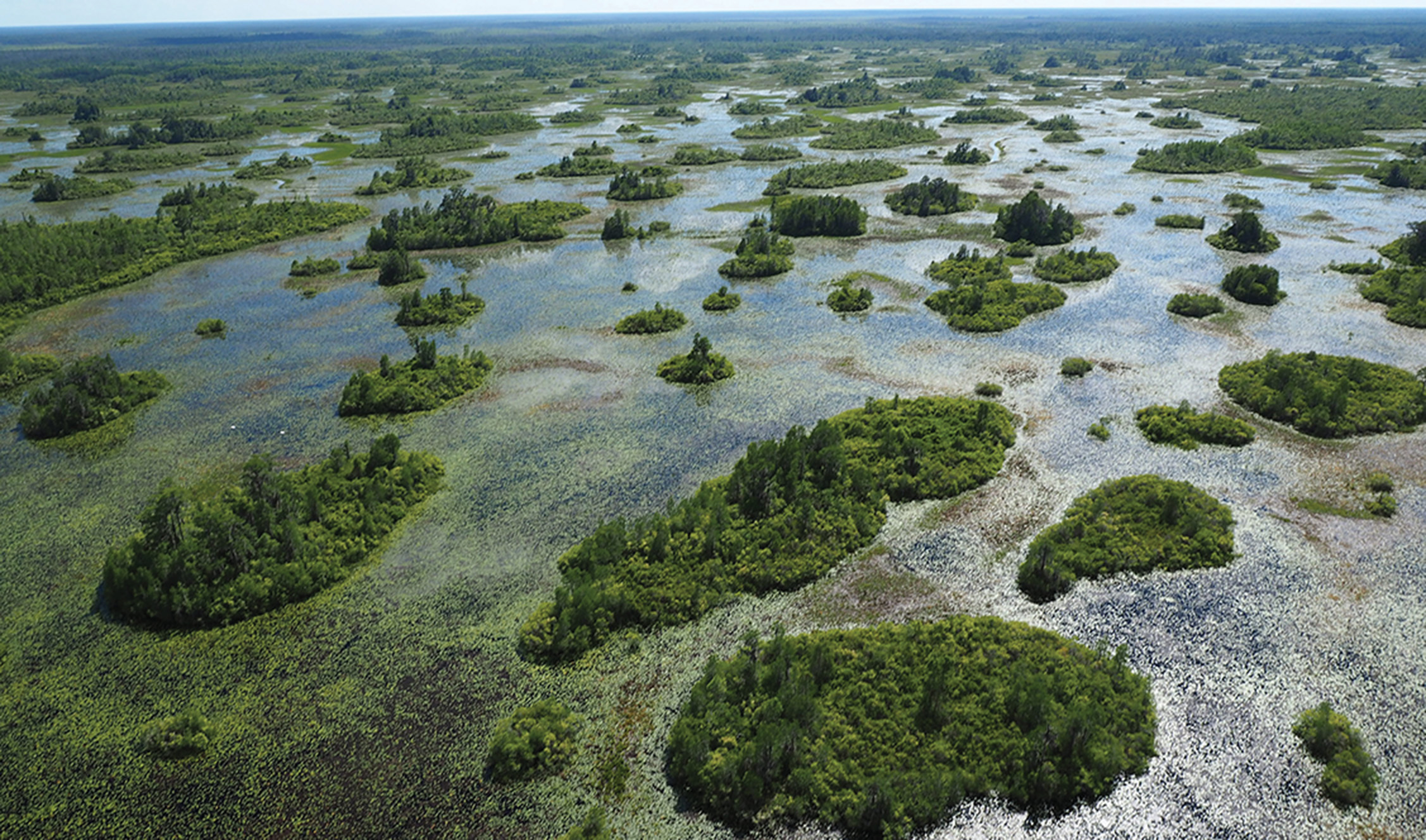
But the “Oke” (pronounced “OH-kee”), as it’s known to its legion of fans around the world, defies expectations in every possible way. At more than 438,000 acres, it’s the largest blackwater wetland in North America, protected by the largest national wildlife refuge and third largest wilderness area east of the Mississippi. It’s a biodiversity hotspot, hosting more than 1,000 species of plants and animals, and it’s home to an International Dark Sky park due to its legendary stargazing. The Oke fights climate change, too, storing about 500 million tons of CO2 equivalent in its peat beds.
The swamp has enormous cultural importance as well. It’s part of the ancestral homeland for the Muscogee (Creek) Nation; “Okefenokee” means “Land of the Trembling Earth” in their language. It’s also sacred space for the Black community, having served as an outdoor sanctuary when the beaches of Georgia and Florida were off limits due to segregation. And the Oke is a tourist magnet, attracting nearly 800,000 visitors annually. For these reasons and more, the Oke was nominated to join the UNESCO World Heritage Site list of the most significant cultural and natural places on the planet. If the designation is granted as expected in July, the Oke would be the first national wildlife refuge in the United States to achieve such recognition.
Unfortunately, the same geologic feature that created—and protects—the swamp also contains a grave threat to its continued existence. A massive sand formation called Trail Ridge along the eastern edge of the Oke keeps the groundwater from leaking eastward out of the swamp while directing rainwater in. But the ridge also contains titanium—and not the type used for fighter jets or hip replacements. This titanium can be processed into titanium dioxide, a mineral used for whitening paint, toothpaste, and the white filling in Oreo cookies, of all things. As a result, mining companies have targeted Trail Ridge at the swamp for the last 30 years. In the 1990s, the DuPont chemical company secured 38,000 acres along the Oke’s entire eastern boundary with plans for a 50-year strip mining project—and changed the course of my life.
It’s hard to imagine a more unlikely Southern swamp advocate. I grew up about a half-hour drive east of Manhattan, where the closest I came to a swamp was watching the 1950s horror movie Creature from the Black Lagoon. My initial exposure to forests, mountains, or wilderness was watching Wild Kingdom with Marlin Perkins and The Undersea World of Jacques Cousteau. Those shows captured my imagination and led to a series of summer adventure trips throughout high school, which in turn pointed me toward Hanover for college.
At Dartmouth, the environment defined my tenure. Majoring in geography allowed me to combine ecology and environmental policy, and I filled my free time rock climbing behind the Skiway and kayaking on the river. When choosing a foreign study program, it had to be the Kenya environmental studies trip, which combined a wildlife safari in the Maasai Mara, homestays with the Samburu people, and analysis of the challenging relationship between wildlife and the surrounding communities. It was a theme I would return to professionally.
Following graduation, I worked around the country for a series of environmental NGOs trying to protect old-growth forests and endangered species as well as for pro-environment congressional candidates seeking reelection. Then the Sierra Club brought me to Georgia in 1997 to help lead the fight against DuPont’s strip mine.
We used all the tools in the campaign toolbox: In the days before laptops and smartphones, we gathered 20,000 handwritten petition signatures and delivered them to the company’s CEO. We lobbied Georgia’s governor and senators and helped arrange a visit by the U.S. secretary of the interior, who famously said titanium was a very common mineral next to a very uncommon swamp; he also told DuPont to pursue its junk food coloring someplace else. We organized a coalition of such strange bedfellows as motorcycle riders and members of garden clubs and a group called “DDS: Dentists Defending the Swamp,” led by my father-in-law, a conservative Republican orthodontist from the Deep South of Georgia. The group’s tagline was “Taking a bite out of DuPont!” We even organized a shareholder resolution calling on the company to abandon its project, which garnered nearly 50 million shares in support.
And we won. After facing years of nearly universal opposition, DuPont agreed to abandon the project and sell its mineral rights. I went back to law school, hoping to be an environmental litigator fighting to save other communities from toxic pollution. But the Oke and I were not done with each other. Several years later, DuPont donated 16,000 acres along the swamp’s northeastern boundary to The Conservation Fund, and my Atlanta-based law firm assigned me to close the deal. We placed a conservation easement forever prohibiting mining on the land and donated 6,700 acres to the refuge. It was cause for celebration in Georgia and beyond. We had saved the day. If DuPont, the world’s biggest titanium mining company, had given up, who else would try?
We found out 13 years later. In 2018, Twin Pines Minerals, run by former coal miners, bought nearly 8,000 acres immediately south of the land DuPont had targeted with the hope of developing a titanium strip mine. The Alabama-based company’s plan would eventually rival DuPont’s. Publicly, it promised the mine would save a poor community desperate for a better financial future. It was my father-in-law who alerted me to the new threat and, as he lay dying in early 2020, urged me to again step up for the Oke.
So, from 2020 through the summer of 2025, I returned to lead this second fight against titanium miners. Under the banner of a new group called Georgians for the Okefenokee, we helped send more than 250,000 objecting comments to permitting authorities. We encouraged independent scientific experts, who normally hold opinions close, to publicize their conclusions that mining would irreparably damage the swamp and that the state regulator’s analysis of the project was grossly defective. We organized a diverse coalition of clergy, students, and institutional investors to weigh in with letters and events. We exposed Twin Pines’ record of environmental and safety violations and financial mismanagement across four states.
Meanwhile, we fought a separate battle with Chemours, to which DuPont had spun off its titanium mining business in 2015. Chemours was being solicited to buy Twin Pines and expand the mining project northward onto the property DuPont had leased 20 years before. So, we initiated shareholder resolutions against Chemours, urging it to permanently abandon Okefenokee mining. We also initiated resolutions against two of the firm’s potential customers—Home Depot and Sherwin-Williams—urging them to pledge not to use Okefenokee titanium in their products.
We also brainstormed a more permanent solution: a state law prohibiting mining along the swamp’s edge. Despite warnings that the mining industry could retaliate, the bill garnered nearly 100 bipartisan cosponsors in the Georgia House for four consecutive years, though it was repeatedly blocked from passing. So, we exposed more than $150,000 in campaign contributions to Georgia’s governor and other elected leaders by Twin Pines and other mining interests that wanted to stop the mining ban. Outside the legislature, we generated investigative and opinion coverage by national media outlets and highlighted how sustainable tourism, if properly managed, could lift the local community far better than a short-term mining operation. After five years, the hard work paid off.
In June 2025, 26 years after DuPont abandoned its dangerous scheme, Twin Pines did the same thing and sold its land to my old client, The Conservation Fund. It was an amazing victory, a huge relief, and personally gratifying on so many levels, none more so than knowing that I had fulfilled a promise to a dying man.
However, the Oke remains vulnerable to this day. The local landowner that leased its land to DuPont in the 1990s continues to pursue a mining project with Chemours, which has refused to renounce mining at the swamp. Gov. Brian Kemp remains silent, refusing requests from every corner of the state to take action.
Undaunted, we continue to educate the public and press the state to either prohibit mining along the swamp’s edge or acquire the remaining unprotected lands. In perhaps my proudest moment, my son Charlie, a college film major, has inherited the underdog gene and is making a documentary about the swamp and the 30-year history of mining fights. Seeing his passion for spotlighting the beauty of nature and environmental advocacy gives me hope the Oke will remain in good hands for generations to come.
Thinking back to my first night in the swamp, I wonder if perhaps those gators weren’t focused on their next meal but were testing me to see if I scared easily. After 30 years, I’m hoping I’ve passed that test.
Josh Marks is an Atlanta attorney and president of Georgians for the Okefenokee.