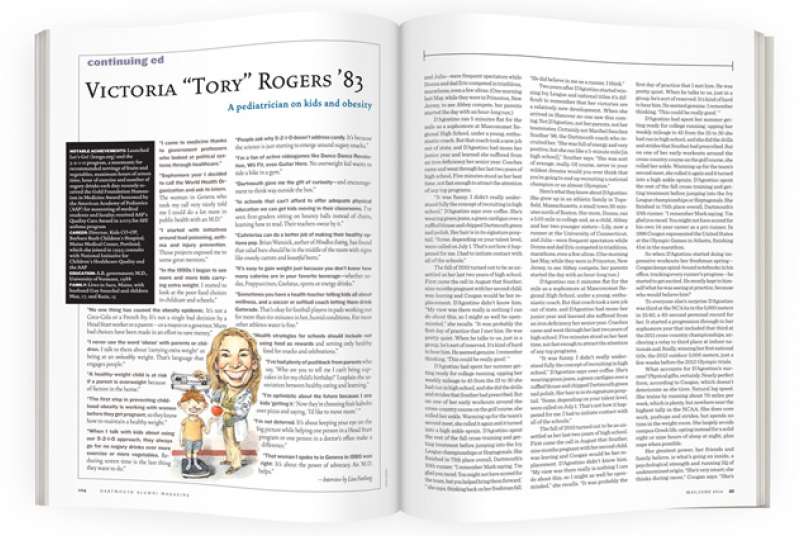
Victoria “Tory” Rogers ’83
Notable Achievements: Launched Let’s Go! (letsgo.org) and the 5-2-1-0 program, a mnemonic for recommended servings of fruits and vegetables, maximum hours of screen time, hour of exercise and number of sugary drinks each day; recently received the Gold Foundation Humanism in Medicine Award bestowed by the American Academy of Pediatrics (AAP) for mentoring of medical students and faculty; received AAP’s Quality Care Award in 2003 for AH! asthma program
Career: Director, Kids CO-OP, Barbara Bush Children’s Hospital, Maine Medical Center, Portland, which she joined in 1995; consults with National Initiative for
Children’s Healthcare Quality and the AAP
Education: A.B. government; M.D., University of Vermont, 1988
Family: Lives in Saco, Maine, with husband Guy Senechal and children Max, 17, and Katie, 15
“I came to medicine thanks to government professors who looked at political systems through healthcare.”
“Sophomore year I decided to call the World Health Organization and ask to intern. The woman in Geneva who took my call very nicely told me I could do a lot more in public health with an M.D.”
“I started with initiatives around lead poisoning, asthma and injury prevention. Those projects exposed me to some great mentors.”
“In the 1990s I began to see more and more kids carrying extra weight. I started to look at the poor food choices in childcare and schools.”
“No one thing has caused the obesity epidemic. It’s not a Coca-Cola or a French fry. It’s not a single bad decision by a Head Start worker or a parent—or a mayor or a governor. Many bad choices have been made in an effort to save money.”
“I never use the word ‘obese’ with parents or children. I talk to them about ‘carrying extra weight’ or being at an unhealthy weight. That’s language that engages people.”
“A healthy-weight child is at risk if a parent is overweight because of factors in the home.”
“The first step in preventing childhood obesity is working with women before they get pregnant, so they know how to maintain a healthy weight.”
“When I talk with kids about using our 5-2-1-0 approach, they always go for no sugary drinks over more exercise or more vegetables. Reducing screen time is the last thing they want to do.”
“People ask why 5-2-1-0 doesn’t address candy. It’s because the science is just starting to emerge around sugary snacks.”
“I’m a fan of active videogames like Dance Dance Revolution, Wii Fit, even Guitar Hero. No overweight kid wants to ride a bike in a gym.”
“Dartmouth gave me the gift of curiosity—and encouragement to think way outside the box.”
“In schools that can’t afford to offer adequate physical education we can get kids moving in their classrooms. I’ve seen first-graders sitting on bouncy balls instead of chairs, learning how to read. Their teachers swear by it.”
“Cafeterias can do a better job of making their healthy options pop. Brian Wansick, author of Mindless Eating, has found that salad bars should be in the middle of the room with signs like crunchy carrots and beautiful beets.”
“It’s easy to gain weight just because you don’t know how many calories are in your favorite beverage—whether sodas, Frappuccinos, Coolatas, sports or energy drinks.”
“Sometimes you have a health teacher telling kids all about wellness, and a soccer or softball coach letting them drink Gatorade. That’s okay for football players in pads working out for more than 60 minutes in hot, humid conditions. For most other athletes water is fine.”
“Health strategies for schools should include not using food as rewards and serving only healthy food for snacks and celebrations.”
“I’ve had plenty of pushback from parents who say, ‘Who are you to tell me I can’t bring cupcakes in for my child’s birthday?’ I explain the association between healthy eating and learning.”
“I’m optimistic about the future because I see kids ‘getting it.’ Now they’re choosing fruit kabobs over pizza and saying, ‘I’d like to move more.’ ”
“I’m not deterred. It’s about keeping your eye on the big picture while helping one person in a Head Start program or one person in a doctor’s office make a difference.”
“That woman I spoke to in Geneva in 1980 was right: It’s about the power of advocacy. An M.D. helps.”