Their Future Is Now
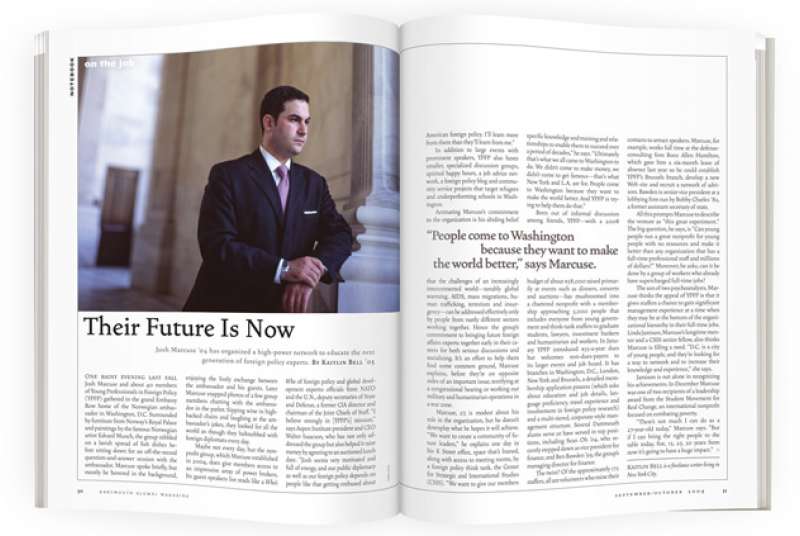
One rainy evening last fall Josh Marcuse and about 40 members of Young Professionals in Foreign Policy (YPFP) gathered in the grand Embassy Row home of the Norwegian ambassador in Washington, D.C. Surrounded by furniture from Norway’s Royal Palace and paintings by the famous Norwegian artist Edvard Munch, the group nibbled on a lavish spread of fish dishes before sitting down for an off-the-record question-and-answer session with the ambassador. Marcuse spoke briefly, but mostly he hovered in the background, enjoying the lively exchange between the ambassador and his guests. Later Marcuse snapped photos of a few group members chatting with the ambassador in the parlor. Sipping wine in high-backed chairs and laughing at the ambassador’s jokes, they looked for all the world as though they hobnobbed with foreign diplomats every day.
Maybe not every day, but the nonprofit group, which Marcuse established in 2004, does give members access to an impressive array of power brokers. Its guest speakers list reads like a Who’s Who of foreign policy and global development experts: officials from NATO and the U.N., deputy secretaries of State and Defense, a former CIA director and chairman of the Joint Chiefs of Staff. “I believe strongly in [YPFP’s] mission,” says Aspen Institute president and CEO Walter Isaacson, who has not only addressed the group but also helped it raise money by agreeing to an auctioned lunch date. “Josh seems very motivated and full of energy, and our public diplomacy as well as our foreign policy depends on people like that getting enthused about American foreign policy. I’ll learn more from them than they’ll learn from me.”
In addition to large events with prominent speakers, YPFP also hosts smaller, specialized discussion groups, spirited happy hours, a job advice network, a foreign policy blog and community service projects that target refugees and underperforming schools in Washington.
Animating Marcuse’s commitment to the organization is his abiding belief that the challenges of an increasingly interconnected world—notably global warming, AIDS, mass migrations, human trafficking, terrorism and insurgency—can be addressed effectively only by people from vastly different sectors working together. Hence the group’s commitment to bringing future foreign affairs experts together early in their careers for both serious discussions and socializing. It’s an effort to help them find some common ground, Marcuse explains, before they’re on opposite sides of an important issue, testifying at a congressional hearing or working out military and humanitarian operations in a war zone.
Marcuse, 27, is modest about his role in the organization, but he doesn’t downplay what he hopes it will achieve. “We want to create a community of future leaders,” he explains one day in his K Street office, space that’s loaned, along with access to meeting rooms, by a foreign policy think tank, the Center for Strategic and International Studies (CSIS). “We want to give our members specific knowledge and training and relationships to enable them to succeed over a period of decades,” he says. “Ultimately that’s what we all came to Washington to do. We didn’t come to make money, we didn’t come to get famous—that’s what New York and L.A. are for. People come to Washington because they want to make the world better. And YPFP is trying to help them do that.”
Born out of informal discussion among friends, YPFP—with a 2008 budget of about $58,000 raised primarily at events such as dinners, concerts and auctions—has mushroomed into a chartered nonprofit with a membership approaching 5,000 people that includes everyone from young government and think-tank staffers to graduate students, lawyers, investment bankers and humanitarian aid workers. In January YPFP introduced $35-a-year dues but welcomes non-dues-payers to its larger events and job board. It has branches in Washington, D.C., London, New York and Brussels, a detailed membershipapplication process (which asks about education and job details, language proficiency, travel experience and involvement in foreign policy research) and a multi-tiered, corporate-style management structure. Several Dartmouth alums serve or have served in top positions, including Sean Oh ’04, who recently stepped down as vice president for finance, and Ben Bawden ’99, the group’s managing director for finance.
The twist? Of the approximately 175 staffers, all are volunteers who mine their contacts to attract speakers. Marcuse, for example, works full time at the defense-consulting firm Booz Allen Hamilton, which gave him a six-month leave of absence last year so he could establish YPFP’s Brussels branch, develop a new Web site and recruit a network of advisors. Bawden is senior vice president at a lobbying firm run by Bobby Charles ’82, a former assistant secretary of state.
All this prompts Marcuse to describe the venture as “this great experiment.” The big question, he says, is “Can young people run a great nonprofit for young people with no resources and make it better than any organization that has a full-time professional staff and millions of dollars?” Moreover, he asks, can it be done by a group of workers who already have supercharged full-time jobs?
The son of two psychoanalysts, Marcuse thinks the appeal of YPFP is that it gives staffers a chance to gain significant management experience at a time when they may be at the bottom of the organizational hierarchy in their full-time jobs. Linda Jamison, Marcuse’s longtime mentor and a CSIS senior fellow, also thinks Marcuse is filling a need. “D.C. is a city of young people, and they’re looking for a way to network and to increase their knowledge and experience,” she says.
Jamison is not alone in recognizing his achievements. In December Marcuse was one of two recipients of a leadership award from the Student Movement for Real Change, an international nonprofit focused on combating poverty.
“There’s not much I can do as a 27-year-old today,” Marcuse says. “But if I can bring the right people to the table today, five, 15, 25, 30 years from now it’s going to have a huge impact.”
Kaitlin Bell is a freelance writer. She lives in New York City.