


It’s raining lightly as the bus pulls into the central station in Kyiv, Ukraine, 16 hours after we left Warsaw, Poland. Passengers in heavy winter coats wait for buses departing to Romania, Germany, Moldova, and cities across Ukraine. The December mist is heavy, muting the early morning light, and the city fades around us into a concrete-colored fog—perfect weather, from a security perspective, in a country where enemies above are looking for targets. Ukraine’s sky has been closed to civilian use since the Russian invasion in 2022, and it takes full days of traveling east to get here. My shoulder already aches from carrying my body armor, which I’ll use while shadowing ambulance crews in the east.
As a journalist and paramedic, my work in war, natural disaster, and other high-risk contexts for outlets has led to a parallel career teaching journalists and humanitarians how to stay safe. On previous trips to Ukraine, I’ve served as a safety and medical trainer. This time, I’ve come as a journalist—to observe. The first time I visited Ukraine, soon after the Russian invasion, bombed-out Russian tanks lined the highway to Kyiv and eastern cities felt like haunted ghost towns, populated by the constant, eerie wail of air alert sirens. That was a long time ago. Millions of Ukrainians have since returned home.
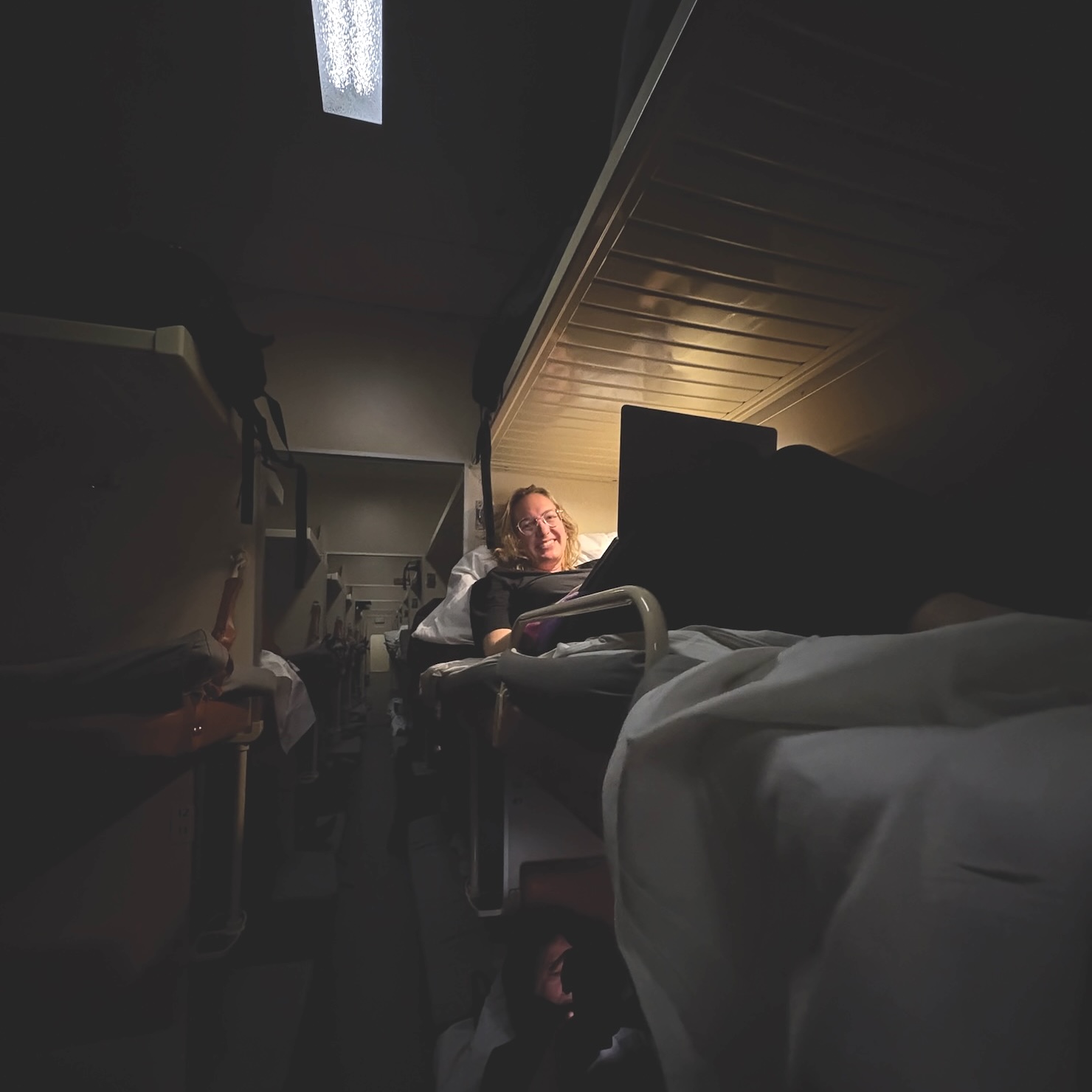
On this two-week trip, I’m here to explore how everyday life continues against a backdrop of the war. Hundreds of Russian drones flock the skies every night, but then in the morning a truck collects household garbage and snow is shoveled neatly from the roads. Ukrainian journalist Julia Kochetova wrote that “the war will be everywhere, even if it isn’t obvious.” No one knows exactly how many people have died in this war, but cemeteries are overcrowded and funeral costs have soared.
Home for Christmas
“It feels both normal and weird at the same time,” says Kyrylo Fomin ’26 over a smoothie in Kyiv, the capital, four days into his first trip home since the war began. When Ukraine imposed martial law after the Russian invasion, travel restrictions prohibited young men from leaving the country—effectively stranding abroad Fomin, Zakhar Podolets ’27, and many other Ukrainian men pursuing higher education internationally. These restrictions were eased last August, allowing Fomin and Podolets to travel home for the first time in years.
In many ways, Kyiv is just as Fomin remembers from his childhood: city streets decorated for Christmas, seeing family and friends, catching up with former teachers. The air alarms, ever-present military uniforms, and power outages are new. Fomin’s grandparents live in a village near Irpin and Bucha, where Russian forces repeatedly shelled evacuating civilians and mass graves have shown evidence of executions and torture. During the invasion, his grandparents spent more than two winter weeks without power, running water, or heat before being evacuated. When Fomin visited his grandparents in December, there were “a lot of traces of battles, many new memorials,” he says. The local car wash and church are pocked with bullet holes.
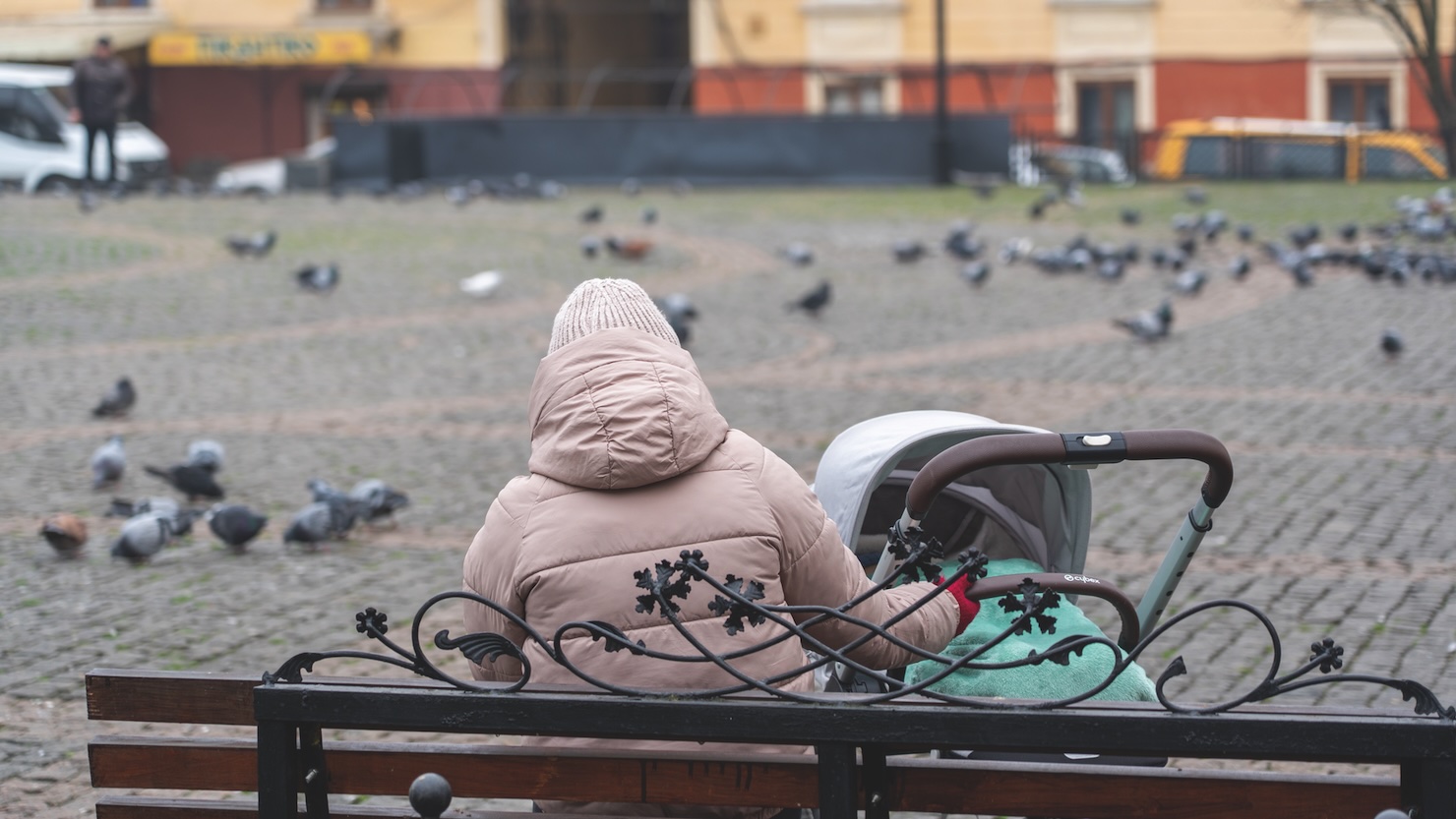
After five years away, it took Podolets a week to get used to the sound of his own accent in Ukrainian. Soon after he returned home to Lviv in western Ukraine, a Russian drone and missile attack destroyed power infrastructure nearby, leaving the city with four hours of electricity a day. Lviv is near the border with Poland, about 1,000 kilometers from the front line, and is targeted by Russian attacks less frequently than Kyiv and eastern cities. The war here takes on other forms: hundreds of thousands of internally displaced Ukrainians settling in the city, grassroots advocacy and fundraising to support the war effort, and friends and family in the military.
In the neighborhood on the outskirts of the city where he grew up, Podolets says Lviv’s increased population has led to gridlock traffic every morning. Despite returning home to an active war, Podolets’ trip is full of typical holiday break activities: lots of time with family, a dentist appointment, renewing government documents—and, in Lviv’s increased traffic, learning how to drive.
Moment in Time
For Ukrainians, Russia’s full-scale invasion of Ukraine on February 24, 2022, was a moment akin to the bombing of Pearl Harbor or the September 11 attacks for many Americans. “The first two weeks of the invasion, it was madness. We didn’t know what would happen next,” says Veronika Yadukha, Adv’23. She cofounded Ukraine’s only literary and translation festival, Translatorium, and as a transmedial translator—literally “across mediums”—she transposes written words into ceramics.
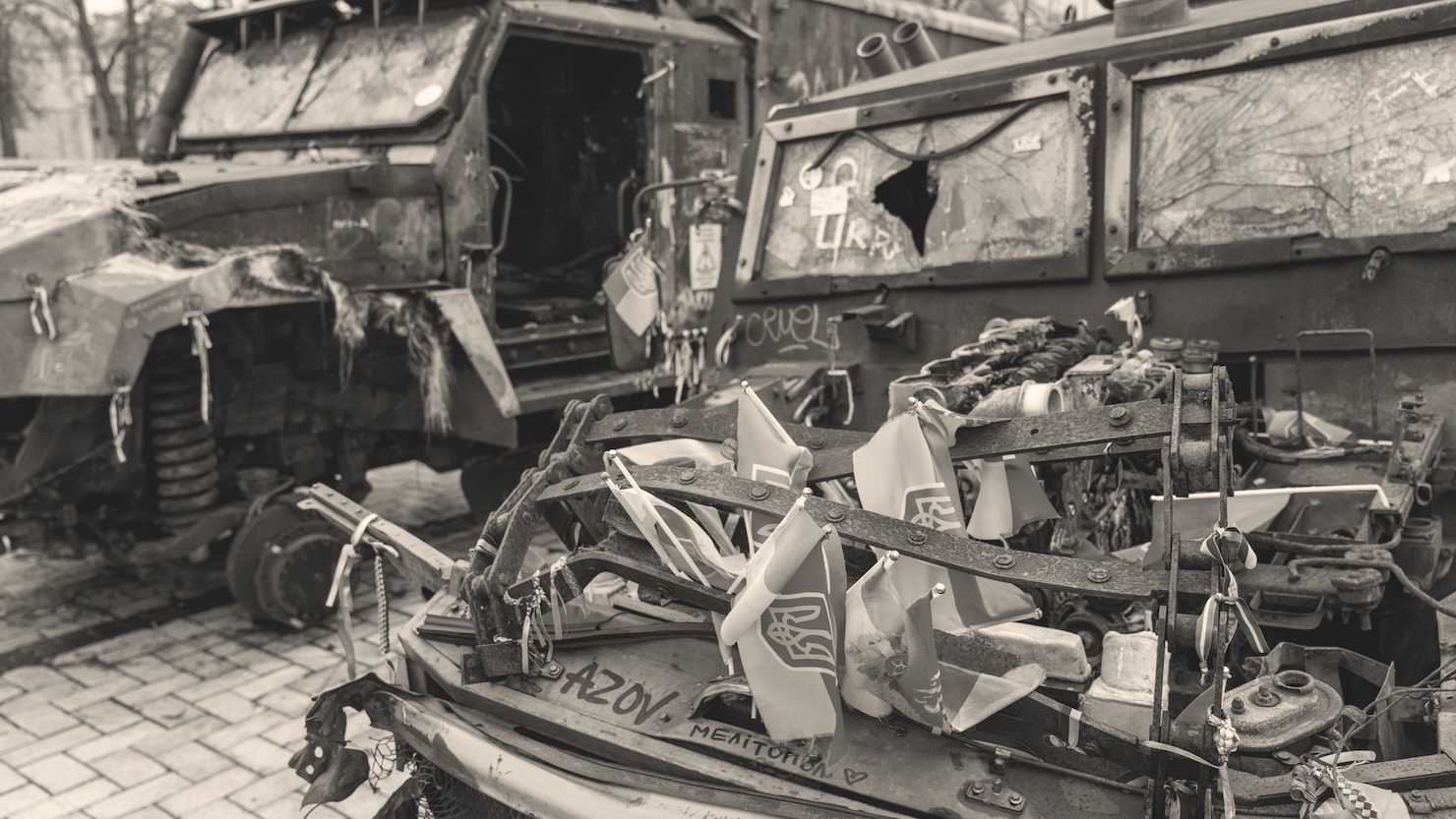
“It was a very difficult time for me,” says Tetiana “Tanya” Savchynska, Adv’18, about the Russian invasion. “I wasn’t sure to which extent we were prepared to face what was coming as a country.” Savchynska is a former military translator, trained combat medic, and university lecturer who took part in the 2014 “Revolution of Dignity” that led to the overthrow of the president at the time. As the war stretches on, Savchynska says it is increasingly difficult to remember a time before the war. “No one is as tired of the war as Ukrainians are, and nobody wants it to be over as much as we do,” she says. “But after everything, it’s not just a peace that we dream of, it’s a just peace.”
Because of the war, Tonia Zakorchemna ’23 made the difficult decision to put her Dartmouth engineering education indefinitely on hold. She was in Kyiv during the invasion and sheltered in a metro station for a night before evacuating. Back at Dartmouth, Zakorchemna threw herself into her studies and advocacy—she’s a former president of the Dartmouth Student Alliance for Ukraine—but felt a deep pull to return to Ukraine. She returned first to found an educational online platform during Covid and later to work with defense technologies. “I hope I will return to Dartmouth when there is a stable peace,” she says, “but I know that my biggest responsibility is to contribute to the fight right now. I have to be back in Ukraine.”
Rehearsal
The children’s theater rehearsal has just ended, and I’m taking a group photograph when the air alert begins to wail. The director quickly checks local Telegram channels, which track aerial threats by neighborhood. Two shahed-type drones are headed this way.
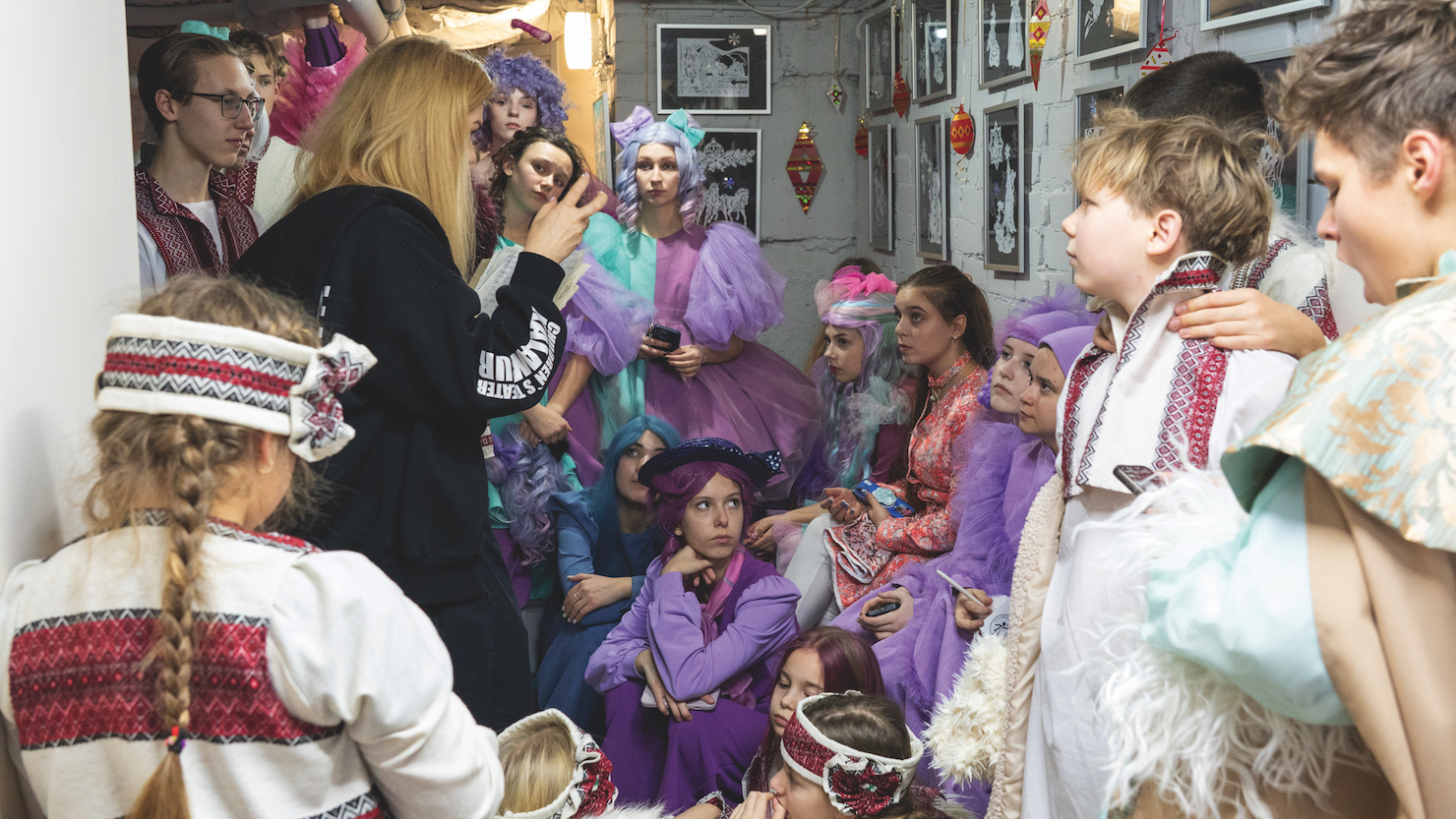
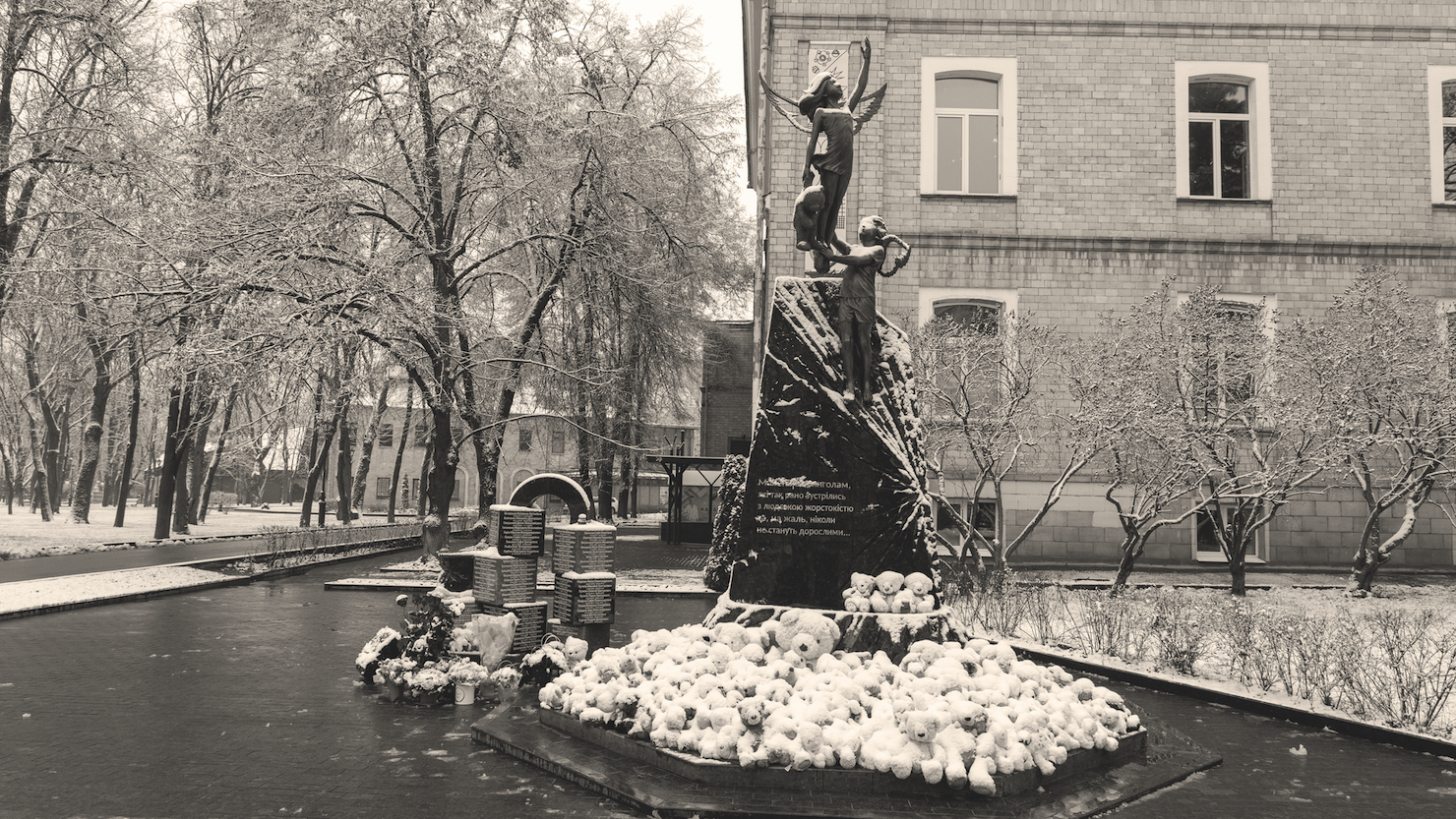
“We should shelter,” the director says with resignation, and two dozen children—still in costume—calmly but quickly walk a maze of staircases and hallways to an underground shelter. Once there, the director debriefs the actors on their rehearsal performance with meticulous notes. About 15 minutes later the air alert clears—the shaheds are no longer in the area. We return upstairs, only to head back down 20 minutes later when the siren sounds again.
In the shelter after the rehearsal debrief, the children gather around me, giggling. Some attend private schools in person; others attend schools in underground metro stations or have had classes online since Covid, and then the war, interrupted their educations. “What is it like in America?” the children ask, curious, shy, and smiling.
Weight of Stories
The stories come from all directions. One Ukrainian translator I’m working with left her job as a journalist for what she calls a less stressful position investigating Russian war crimes. Another translator is late to our first day of work because her husband was recently injured by a rocket-propelled grenade for the third time and their 3-month-old had been up all night, cooing and reaching for his toes.
The war entered its fifth year in February. During this time, Ukraine’s “normal” has turned decidedly grim: Everyone knows people who have died. A few days earlier, a ballistic missile was shot down near a children’s park, where lines of strollers and toy cars are carefully set out alongside a miniature Ukrainian Railways train just big enough for child passengers. A caretaker throws breadcrumbs to the ducks, shooing the pigeons away.
Scenes from Ukraine’s eastern front lines are otherworldly. Roadways are draped in netting to protect vehicles from Russian drones. Military jamming often breaks communication between a drone and its operator, which also makes my Google Maps location skip frenetically between the North Pole and Lima, Peru. To bypass jamming, some drones are physically connected to their operator, unspooling lightweight fiberoptic cable behind them as they fly. After the drone crashes or is destroyed, the fallen cables blanket the landscape like spiderwebs, sparkling in the sun.
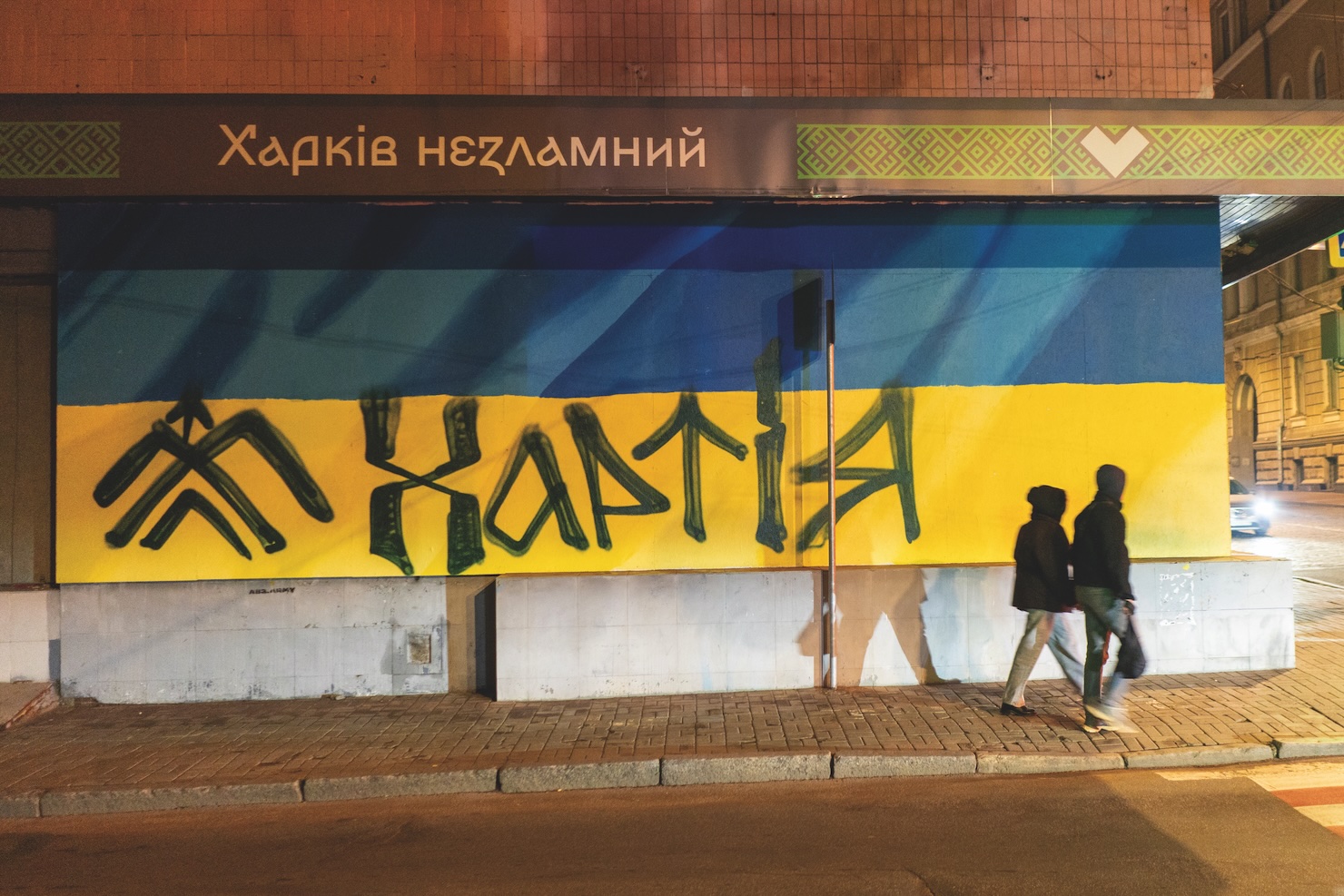
On a long train ride, an electronic musician tells me the colors of a wartime sunrise are more vivid than a sunrise at peace, and that his elderly relatives claim to hear screams of the wounded on a front line that’s 700 kilometers away. “Nothing but this war could prepare someone for this war,” he says. The stories accumulate, running through my mind like a filmstrip, too much and too fast to absorb. At checkpoints, soldiers see my press pass and thank me for being here. I thank them in return, wishing I could do so much more.
“The Situation Is as Follows”
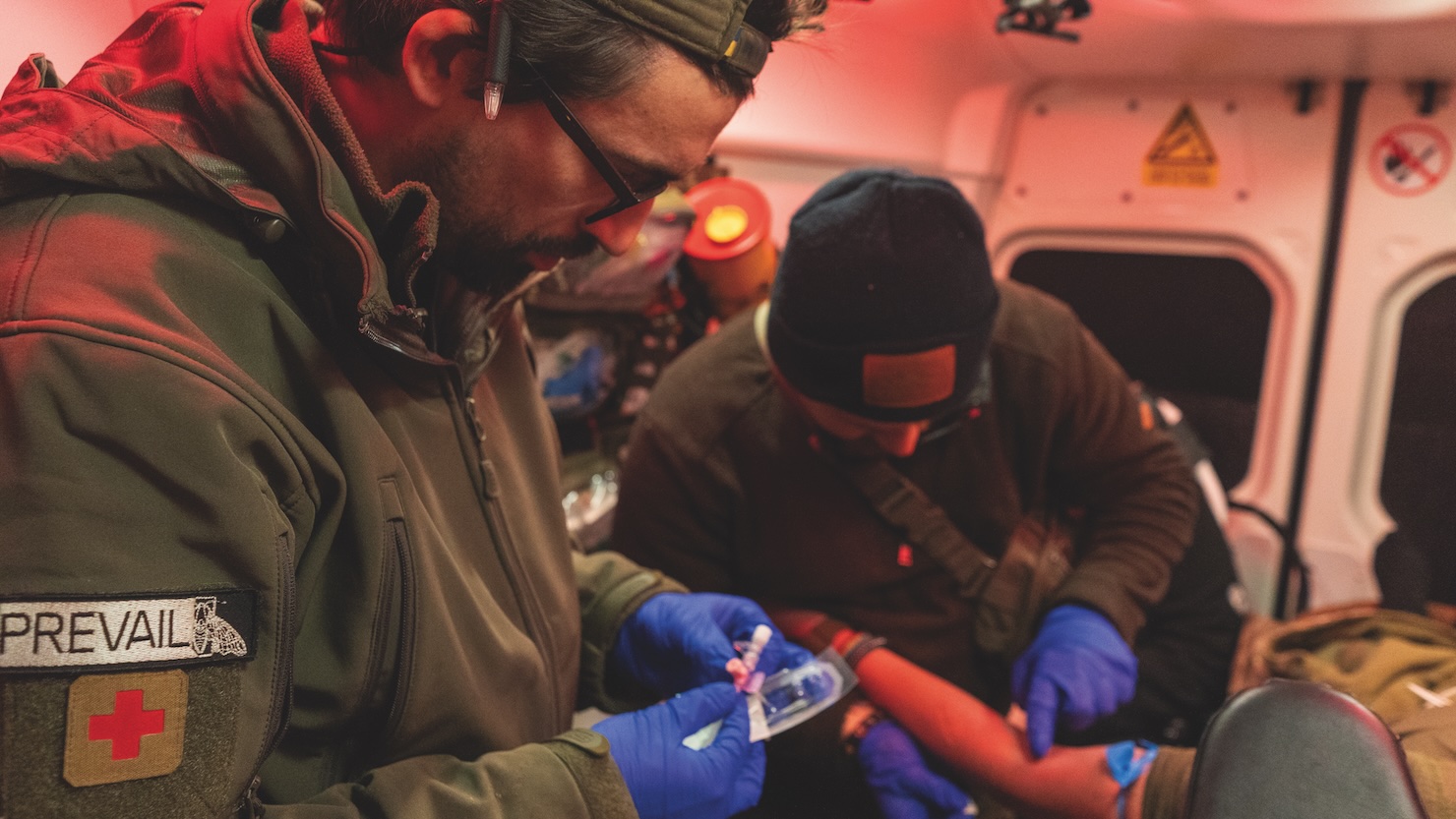
I spend as much time as I can on ambulances in eastern Ukraine. As a paramedic, I’m curious about how things work here; as a journalist, I’m here to observe. In Kharkiv, I ride a 12-hour shift on an ambulance that was hit earlier this year in a double tap attack, in which a second strike, launched shortly after the first, targets first responders. One of the two doctors on the crew works during the week at a hospital ward for survivors of the 1986 Chernobyl nuclear disaster. Her fiancé is Georgiy Ivanchenko, a Ukrainian photojournalist who lost his leg after surviving an October drone attack in which his colleague and best friend, Antoni Lallican, was killed. The doctor tells me all this calmly in the back of the ambulance between calls, checking Telegram frequently to track the path of a shahed drone flying nearby.
Several days later, I ride with an ambulance crew of international volunteers, transporting soldiers with frontline injuries to hospitals in the eastern city of Dnipro. In the middle of the night a week earlier, a ballistic missile directly hit a residence two blocks from the crew’s headquarters. They dressed quickly and responded to the attack, pulling the ambulance out of the driveway and wondering if their home had been the intended target.
One soldier says he has stopped getting to know his fellow soldiers. It makes it easier when they die.
On the hourlong ambulance transport between Pavlohrad and Dnipro, soldiers help me with a Duolingo Ukrainian lesson on my phone. They are tired, the soldiers say, but Russia cannot be trusted, and so the war will continue. In the meantime, one soldier says he has stopped getting to know his fellow soldiers. It makes it easier when they die. A young soldier—recently drafted and then almost immediately injured—says he hopes for the best and thinks that everything will work out fine. The others use bandaged hands to wipe tears from their eyes, laughing at this thought. “The situation is as follows,” one soldier says into my phone through Google Translate. “Everyone wants to live.”
Map for the Future
Two days later, I meet Sasha Goldina ’29, who is home during winter break from Dartmouth. We have lunch in Chernivtsi in southwestern Ukraine, which feels like a world away. She was 6 years old—“almost 7”—when soldiers in unmarked uniforms started appearing in her native Crimea in 2014. The Russians “were trying to convince the international community that Ukraine was attacking itself,” she says. Soon after the troops were identified as Russian, her parents fled Crimea with two backpacks and their young daughter. “They left without looking back,” Goldina says, “because they understood that staying there in occupation would mean not having any freedom.”
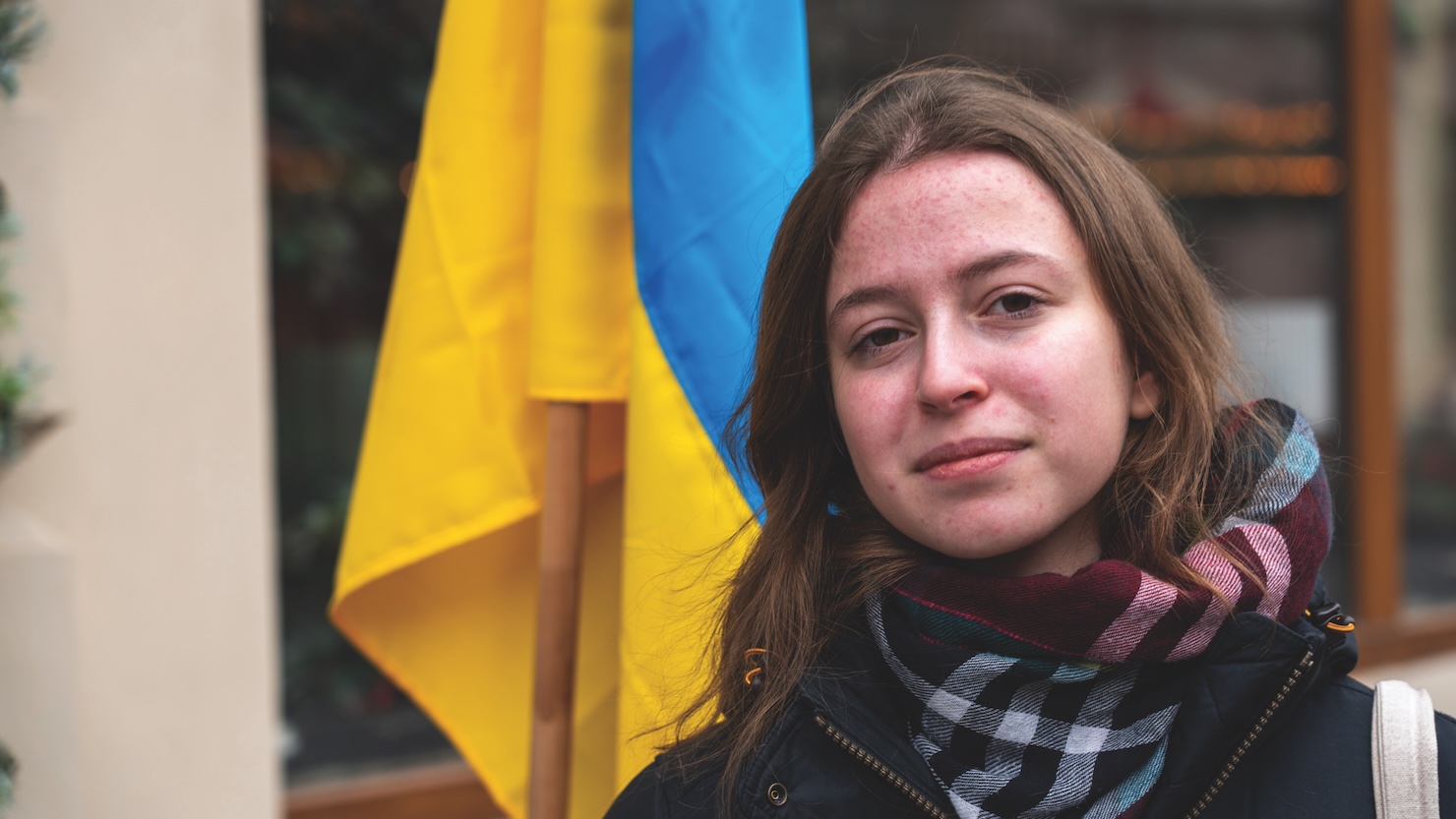
“They left without looking back because they understood that staying there in occupation would mean not having any freedom.”
—Sasha Goldina ’29, on her parents’ decision to leave Crimea when she was 6
After brief stays in Israel, Moldova, and Denmark, Goldina and her parents returned to Ukraine and settled in Chernivtsi, which she has adopted as her honorary hometown. After lunch, she gives me a tour of downtown Chernivtsi, talking about the different empires that have influenced the architecture: Austrian, Romanian, Soviet. “It’s all over the place,” she says. At Dartmouth, people are sometimes surprised that Goldina’s family chose to stay in Ukraine despite the war. “I’ve made the decision to stay in the country with my family over and over again,” Goldina says.
After just one term, Goldina is the newly elected president of the Dartmouth Student Alliance for Ukraine, which has organized vigils, fundraisers, lectures, and installations in Hanover, including a poetry reading during fall term. With guidance from professor Victoria Somoff—who also oversees Dartmouth’s Ukrainian language program—the group has become both a strong advocacy platform and vital social community for Ukrainian students during the four-year war.
When in Hanover, the first thing Goldina does every morning is check the news from home, hoping for no reports of explosions. “Russia is a kind of dragon that does not stop when it’s appeased,” she says. “It just wants more and more.” A viable peace, she says, will require the return of all Russian-occupied territory to Ukraine and real safety guarantees for the country as well as the repatriation of Ukrainian prisoners and children who have been forcefully brought to Russia. “Otherwise, it’s not peace, it’s appeasement,” she says. “It’s just a way to feed the monster for a little bit before it gets hungry and strikes again.”
Rianna Pauline Starheim’s reporting was supported by the International Women’s Media Foundation’s Women on the Ground: Reporting from Ukraine’s Unseen Frontlines initiative, in partnership with the Howard G. Buffett Foundation. View more of her photos in this gallery.